How this was researched: I haven’t used any of these products, and I don’t have a dog. I read about sixty low-star reviews across three motorised dog toy listings — the ones Amazon surfaces on each page — and sorted the complaints by product. That’s a slice rather than a census: each listing has more low-star reviews than I read, and most ratings carry no written review at all. Star percentages are Amazon’s published figures. Nothing here is sponsored. The Amazon links on this page are affiliate links: as an Amazon Associate I earn from qualifying purchases, at no extra cost to you.
All three of these listings carry the same warning: not for aggressive chewers. It is printed in small type on one, in large red type on another, and in the title of the third.
Read the one-star reviews and you find that phrase is doing three completely different jobs, and that most interactive dog toy problems sort themselves by which job it is doing. On one toy it’s an honest limit. On another it’s a footnote to a design that expects to be chewed. On the third it’s a shield — because the dogs tearing that one apart are not aggressive chewers at all.
Interactive dog toy problems, listing by listing
QGI: the warning is accurate, and the real fault is elsewhere
This is the largest listing of the three by a wide margin, and its low-star reviews split cleanly in two.
About half are about the dog. Owners of determined chewers describe stripping the soft top, then the rope, then starting on the housing. A four-month-old puppy hid under the bed when it moved. One owner’s dog just found it too slow. None of that is a manufacturing complaint, and the chewer warning on the listing — small as it is — describes the chewing cases accurately. The dogs doing the damage are the kind of dogs it warns about.
The other half is where the real product issue sits: the battery. Several owners report a charge that held well at first and then stopped, and one describes wheels that quit turning after a few sessions. One long-term owner reports a repurchase that fell apart in fifteen minutes where the original had lasted, and wonders whether quality has dropped.
Verdict: match problems you can screen for, plus a battery fault you should test for in week one. Ordinary for the category. Full review.
Qraxond: the warning is accurate, and the shell is meant to go
Also a roughly even split, but the shape is different because the product is different. It’s a motor ball inside a plush cover held with velcro, and the cover is sold separately as a replacement part.
So when a chewer owner reports the cover gone in two days, that’s the design working as intended — whether or not the buyer knew that going in, and the listing does not make it obvious. What the low-star reviews add that the full review covers in detail: a charging fault at around two months, a ball that won’t stay twisted shut, and legs that curl inward rather than spreading as photographed.
The chewer warning here is printed in large red type, which is more than most manage. The dogs described tearing it up include a self-described champion chewer and a bully breed. Again, the right dogs.
Verdict: the destruction complaints are largely priced in. The charging complaints are the ones to watch.
seagi: the warning is a shield
This one is different, and it took reading the reviews carefully to see why.

The dominant complaint is the same as on the other two: the outer cover comes off. But look at who’s doing it. A Pomeranian whose owner specifically says he isn’t a chewer. A seven-pound teething puppy, described by the owner as not aggressive, just five months old. A twelve-pound dachshund. A Yorkie. A five-pound Havanese. Small dogs, several of them explicitly described as non-chewers, and the cover is gone in five to ten minutes.
That is not what “not for aggressive chewers” is supposed to mean. On the other two listings that phrase draws a line between dogs that destroy toys and dogs that don’t. Here the line does not hold: the toy is not surviving ordinary small dogs doing ordinary things.
Two more details from the reviews reinforce it. One owner notes that the box includes a replacement cover — and describes it as adding a couple more minutes of play before it too is chewed apart. Another bought replacement casings for a blind dog who had learned to get the ball out, and reports the new casings lasting minutes each.
Separately, battery complaints are sharper here than on the other two: one owner reports roughly an hour of runtime, another that the unit stopped charging after about five cycles.
Verdict: the cover is genuinely weak, and the chewer warning doesn’t explain the failures. This is the one of the three where the low-star reviews describe a product problem rather than a dog problem.
The failure all three share, and no listing mentions
There is a category of one-star review here that does not exist for lamps or headphones: the dog ignored it.
It appears on all three listings. A schnauzer that won’t look at the ball. A rat terrier that doesn’t like it at all. Two dogs that walked straight past the octopus. One owner writes, with some resignation, that it works exactly as advertised and their dog simply didn’t care.
There is no fix for this, no way to test for it before buying, and no manufacturer that could reasonably be blamed. It sets a floor on the one-star rate for the whole category, and it is part of why these toys average 3.9 to 4.2 stars where a lamp averages 4.5.
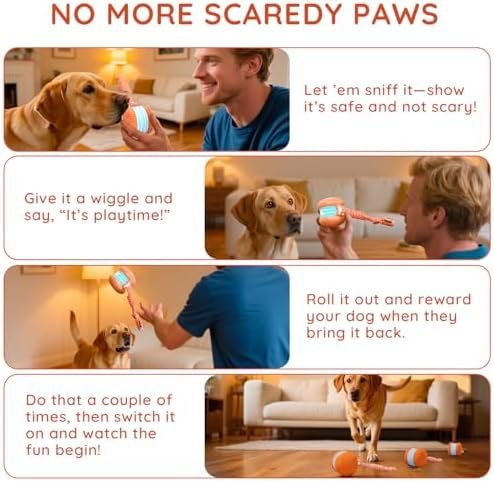
The related failure — the dog is frightened rather than indifferent — is at least partly addressable. One listing publishes a four-step introduction routine, and owners across all three describe the same method independently: put it on the floor switched off, let the dog investigate, then turn it on days later. It doesn’t always work. It’s still the first thing to try.
Interactive dog toy problems and the return badge
Two of the three listings carry Amazon’s “frequently returned item” badge. That badge is worth reading in light of the above, because it does not mean the same thing on both.
On the QGI ball, the low-star reviews are mostly dogs that chewed, feared or ignored it. Those are returns, but they’re mismatches. On the seagi ball, the low-star reviews are mostly covers that failed under ordinary use. Those are returns too, and they’re something else.
The badge tells you people send it back. The reviews tell you why. Reading only the first gets you a warning; reading both gets you a decision.
| Listing | Ratings | Average | 1–2 star | Main issue | |
|---|---|---|---|---|---|
| QGI | 2,484 | 4.2 | 13% | Battery; otherwise dog-match | Check |
| Qraxond | 1,596 | 3.9 | 19% | Charging; shell is a consumable | Check |
| seagi | 542 | 3.9 | 19% | Cover fails with small dogs | Check |
What to check in the first week
Four things, and which ones matter most depends on which toy you bought.
Introduce it switched off. Happy owners on each of these three listings say this. Leave it on the floor for a day before it moves.
Watch the first ten minutes of real play. On the seagi in particular, the cover failures reported happen inside that window. If it survives the first session with your dog, it will probably survive the next.
Run a full charge cycle early. All three have charging complaints; the seagi’s are the most severe. Charge it, run it flat, charge it again, and see whether it comes back.
Keep the box. The ignored-it failure has no test. If your dog isn’t interested by day three, that’s the answer, and the return window is the only remedy.
The reviews behind this
Rating, month and helpful-vote count, so you can find them on each listing yourself. No names and no quoted text — these are summaries in my own words.
| Listing | Rating | Posted | Votes | What it reports |
|---|---|---|---|---|
| QGI | 1 star | Jun 2026 | 1 | Repurchase fell apart in 15 minutes; original had lasted |
| 3 star | Aug 2026 | 0 | Four-month puppy hid under the bed when it moved | |
| 2 star | Jul 2026 | 0 | Chewer stripped the soft top within minutes | |
| 1 star | Jul 2026 | 0 | Wheel torn off, dog chewing toward the battery housing | |
| 2 star | Aug 2026 | 0 | Too slow to interest this dog on either speed | |
| 3 star | Jun 2026 | 0 | Fun, but the charge stopped holding | |
| 1 star | Aug 2026 | 0 | Wheels stopped spinning after a few uses | |
| 1 star | Jun 2026 | 0 | Third motorised ball tried; all broke on day one | |
| Qraxond | 2 star | Aug 2026 | 2 | Two months in, will not take a charge |
| 3 star | Jul 2026 | 1 | Seven months with a 5 lb dog before the velcro gave | |
| 1 star | Aug 2026 | 0 | Hard to find the switch; two dogs walked past it | |
| 3 star | Aug 2026 | 0 | Ball inside will not stay twisted shut | |
| 2 star | Jul 2026 | 0 | Chewer rips it apart at the velcro | |
| 1 star | Aug 2026 | 0 | Legs curl inward; barely wobbles; replacement identical | |
| 3 star | Jul 2026 | 0 | Bouncing too fast; frightened this dog | |
| seagi | 1 star | Feb 2026 | 2 | 7 lb teething puppy, not aggressive, cover chewed in 5 minutes |
| 2 star | Jul 2026 | 1 | Pomeranian, not a chewer, two pieces off in 5 minutes | |
| 1 star | Feb 2026 | 1 | Yorkie chewed the outer case off in the first hour | |
| 1 star | Mar 2026 | 1 | French bulldogs got the charging cap off within two days | |
| 3 star | Mar 2026 | 0 | 12 lb dachshund chewed the cover off in 5 minutes | |
| 1 star | May 2026 | 0 | 5 lb Havanese; piece of cover broke off after 10 minutes | |
| 2 star | Mar 2026 | 0 | Battery lasts about an hour if left on | |
| 2 star | Apr 2026 | 0 | Recharged about five times, then would not charge | |
| 3 star | Jul 2026 | 0 | Works as advertised; dog did not like it | |
| 3 star | Mar 2026 | 0 | Schnauzer will not even look at it | |
| 2 star | Feb 2026 | 0 | Included spare cover adds a couple of minutes before it goes too | |
| 3 star | Jun 2026 | 0 | Bought replacement casings; each lasts minutes once the dog knows the trick |
Read down the seagi rows and note the dogs: Pomeranian, Yorkie, Havanese, dachshund, a seven-pound puppy. Then read the QGI and Qraxond rows for the same complaint and note who’s doing the chewing there. That difference is the whole piece.
Common questions
Are these toys just badly made?
Not uniformly. On the reviews I read, two of the three fail mostly at the hands of dogs the listings warn about, plus a battery fault each. The third fails with ordinary small dogs, which is a different problem.
My dog is scared of it. Is that normal?
Common enough that one manufacturer publishes an introduction routine. Switch it off, leave it on the floor, and give it days. Some dogs come round; some never do.
Why do these average lower than most products?
Because “my dog wasn’t interested” is a one-star review with no product defect behind it, and it appears on every listing. That floor doesn’t exist for most things people buy.
This piece is based on roughly sixty low-star reviews read across three motorised dog toy listings, sorted by product and summarised in my own words. That’s a sample rather than a complete reading — each listing carries more low-star reviews than I went through, and most ratings have no written review attached, so treat “the dogs described were small” as “in what I read” rather than a census of every failure. Star percentages are Amazon’s published figures at the time of writing. Product images are from the manufacturers’ listings.