How this was researched: I haven’t used any of these products. I read roughly a hundred low-star reviews across three aurora projector listings, the ones Amazon surfaces on each page, and sorted the complaints by product. That’s a slice, not a census: each listing has more low-star reviews than I could read, and most ratings carry no written review at all. Star percentages are Amazon’s published figures. Nothing here is sponsored. The Amazon links on this page are affiliate links: as an Amazon Associate I earn from qualifying purchases, at no extra cost to you.
Read enough one-star reviews of aurora projectors and something odd surfaces. Almost nobody says the thing arrived broken.
They say it was great. For about a month.
That timing matters, and so does the fact that the three listings I read don’t fail in the same way at all. One has a specific, repeatable hardware problem. One has a connection problem. One barely has a hardware problem worth naming.
Aurora projector problems, listing by listing
Lumping these together would be the easy version of this article and also the useless one. Aurora projector problems are not one thing, so here is what the low-star reviews on each listing actually say.
MuliVid: the film discs die, and you can’t replace them
This is the only one of the three with a dominant, specific failure, and it’s all over its low-star reviews.
The projector works by shining a lamp through a printed disc, which puts that disc directly in front of a heat source. Owners describe the result in near-identical language: colours washing out, planets going pale, images that were sharp in week one looking faded by week six. One reported the discs going semi-transparent inside a month. Another said theirs was magical for five or six weeks before the colours gave out. A third watched the images lose sharpness over a couple of months of normal use.
Then there’s the part that turns an annoyance into a dead product. A buyer opened the box and found the manual describing the discs as a consumable product, wording that appears nowhere in the listing, with no information about where to buy more. Several owners went looking for replacements and came back empty-handed.
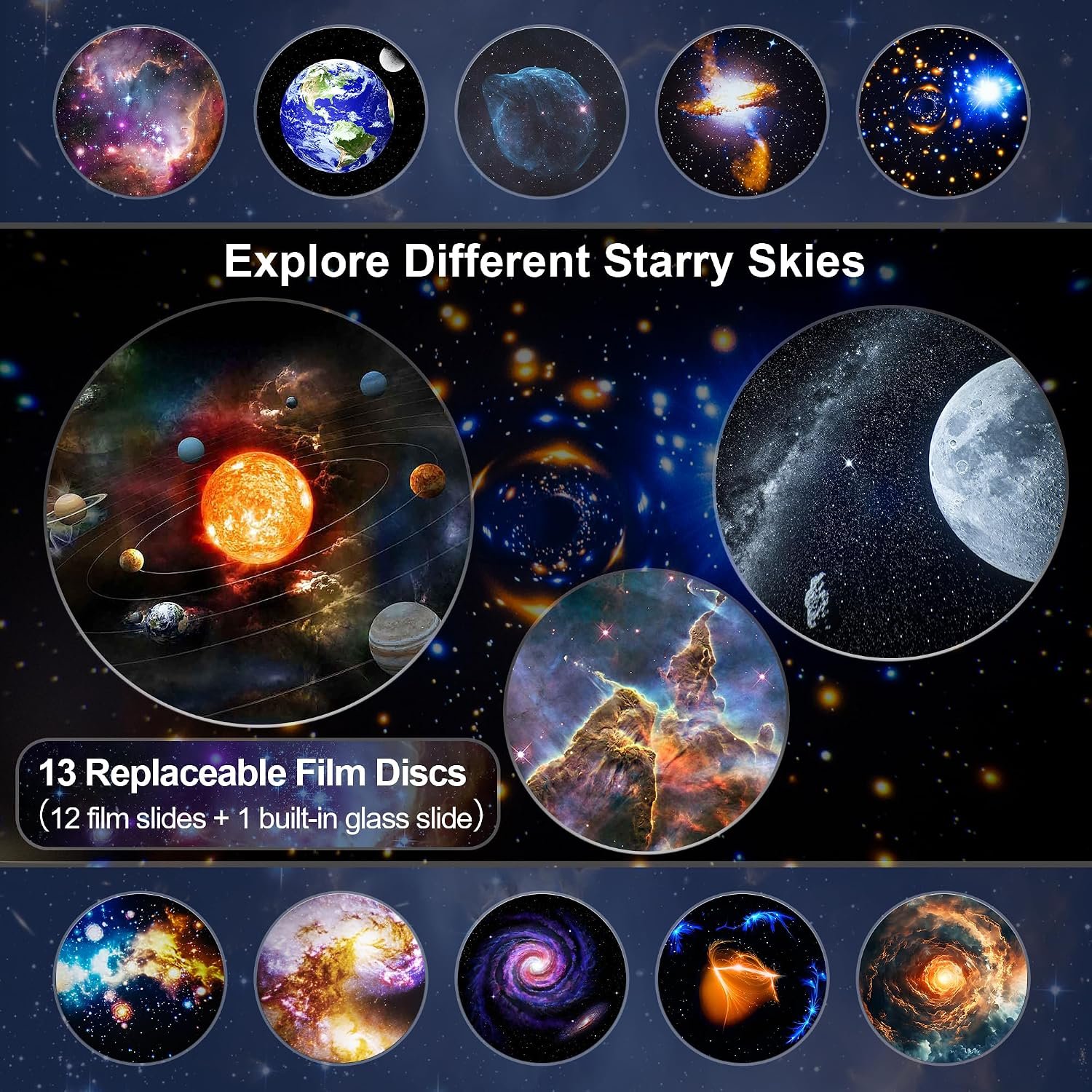
Its other recurring complaints point the same direction. Focus that several owners couldn’t get sharp across the frame. Brightness that a number of them found too weak to reach a ceiling. One reported a unit that ran hot enough to distort its own housing, after which the light came back blue.
Verdict on this one: the complaints are about the hardware, they repeat, and they have a mechanism behind them. That’s the pattern worth taking seriously. If the film-disc idea still appeals — and for a child learning the solar system it might — go in expecting the discs to be a wearing part. Current listing and price.
Govee: it works, then it stops talking to you
Different shape entirely. The Govee low-star reviews are not about light quality, which owners generally rate well. They are about the connection.
Wi-Fi chips that wouldn’t pair out of the box. Matter support that worked and then stopped, pushing an owner back into the app they were trying to avoid. Units that dropped their connection every few weeks and needed resetting. Since this projector has no remote, losing the connection means losing control of it, which is why these complaints read angrier than their severity suggests.
The second thread is motor noise, and it’s genuinely mixed. Some owners describe a grinding or whirring sound that appeared after a few weeks and got worse. Plenty of others on the same listing report near silence. Both groups are describing the same product, which points at assembly variation rather than a design fault. Some units are quiet and stay quiet. Some aren’t. You find out in the first minute, if you bother to listen.
Verdict on this one: no single failure dominates, and nothing structural. The risk is connectivity, and connectivity problems are the kind that show up early enough to return. Worth it if you already run other Govee devices, awkward if you don’t — which is the argument I make at length in the full review. Current listing and price.
Staryou: no real hardware story
This is the one that surprised me, and it’s worth stating plainly rather than inventing a problem to keep the article symmetrical.
Its low-star reviews are dominated by expectation complaints, not hardware ones. The listing promises 300+ modes and owners who counted say it is nowhere near that. The photos make the stars look white and they are green. The moon phases turn out to be physical films you swap rather than settings you change. I went through all of that in the full review, and every bit of it is a marketing problem rather than a manufacturing one.
What’s left after those is thin. A remote that would turn one owner’s unit off but never back on, which repeated on their replacement. Units that stopped at around a month and at around five months. A speed setting that reverts. A timer that can’t be switched off. One owner reported a grinding noise at six months.
None of those repeat often enough in what I read to call a pattern. Scattered faults at roughly the rate you would expect from any consumer electronics listing this size.
Verdict on this one: nothing notable on the hardware side. If you go in knowing what it actually does, the failure risk looks ordinary — and of the three, this is the one whose problems are solved by reading carefully before you order rather than by testing after. Current listing and price.
What the three do share
One thing, and it’s the timing.
Two days. Two weeks. A month. Two months. Five months. Across all three listings, owners open with some version of “we loved it at first” and then describe a decline. One bought a projector as a Christmas gift, used it an hour a night, and watched it dim through January. Another had three good days before the colours started going.
Amazon’s standard return window is 30 days. A large share of what people describe starts after that.
This is not a conspiracy, and I doubt anyone designed it that way. It’s what wear looks like in a device that runs a light source and a small motor for hours a night. But it does mean the usual advice, check it when it arrives and return it if it’s faulty, misses most of what actually goes wrong.
Worth being precise about what I can and can’t tell you here. I know these three fail on different timelines because owners wrote down when it happened. I don’t know what’s physically going on inside any of them, because I haven’t opened one and none of the listings publish a component breakdown. Heat degrading a printed film is the mechanism the MuliVid owners themselves describe, and it’s the one claim in this section with owners behind it. The rest is timing, which is all the reviews can actually tell you.
What to test in week one
Most aurora projector problems cluster past day 30, so the useful question isn’t “does it work?” but “is it going to keep working?” Four things follow, and which ones matter depends on which projector you bought.
Run it hard, not briefly. A few full evenings at the brightness and speed you actually intend to use. Motor noise, flicker and heat all show up under load. Week one is the only week you can act on what you find.
Listen in a silent room. Lights off, nothing else running. Thirty seconds, and it’s the test most likely to catch a bad unit while you can still return it. This is the one that matters most on the Govee.
If it uses film discs, photograph one now. Take a picture of the projection on day one. If you suspect fading at week six you will have something to compare against, and a clear before-and-after is worth more than a description when you contact the seller. This is the MuliVid test.
Feel the housing after an hour. Warm is normal. Hot enough that you don’t want to hold it preceded several of the worst outcomes I read.
The number on the box tells you none of this
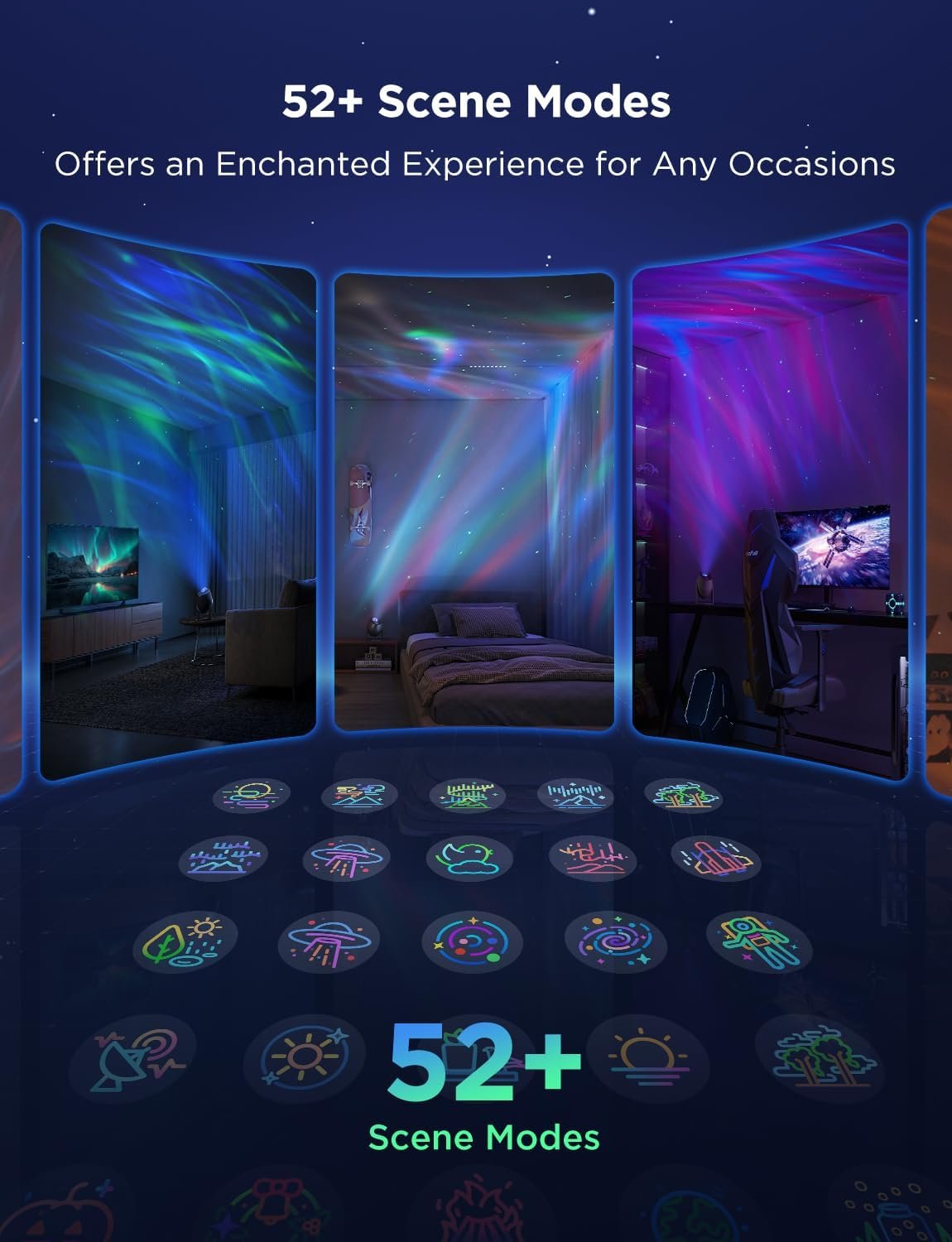
One of these leads with 52 scene modes. Another with more than 300. A third with 13 film discs. Not one says anything about how long the parts producing those modes will last.
That asymmetry is why the low-star reviews are worth reading even when the average is 4.3 or 4.4. The rating tells you whether people were happy. The one-star reviews tell you when they stopped being happy, and on which product.
For the record, none of these three is a bad listing. Their one and two star shares run between 9% and 11%, unremarkable for the category, and I would happily own two of them.
| Listing | Ratings | Average | 1–2 star | Main risk | |
|---|---|---|---|---|---|
| Govee | 890 | 4.3 | 11% | Connectivity | Check |
| Staryou | 958 | 4.4 | 9% | None notable | Check |
| MuliVid | 933 | 4.3 | 10% | Discs wear out | Check |
Notice that the star percentages barely separate them. That is exactly the problem with choosing on ratings alone: the number that would actually have helped you here is not in that table. Full write-ups: Govee and Northern Galaxy.
The reviews this is built on
Since the whole point of this site is reading the low-star reviews, it seems fair to show which ones. Below are the reviews behind each claim above, identified by rating, month and helpful-vote count so you can find them yourself on each listing.
No names and no quoted text: these are summaries in my own words, and the reviewers are people rather than sources who signed up to be cited. The ratings and dates are enough to locate them.
| Listing | Rating | Posted | Votes | What it reports |
|---|---|---|---|---|
| MuliVid | 1 star | May 2026 | 13 | Manual describes the discs as a consumable; no purchase info given |
| 3 star | May 2026 | 11 | Films are not permanent and it is unclear how to buy more | |
| 3 star | Feb 2026 | 10 | Images lost sharpness and colour after a couple of months | |
| 3 star | May 2026 | 5 | Colours fading after about a week on the same disc | |
| 1 star | Jan 2026 | 5 | Focus off across every disc; only the mono moon looked sharp | |
| 1 star | May 2026 | 2 | Slides went see-through within a month from heat | |
| 1 star | Jan 2026 | 1 | Ran hot enough to distort the case; light turned blue | |
| 2 star | Jan 2026 | 1 | Blinking after 3 months; cables, adapters and cooling all ruled out | |
| 1 star | Feb 2026 | 1 | LED dimmed steadily over a month of one hour a night | |
| 3 star | Aug 2026 | 0 | Five to six weeks of use, then colours faded; no replacement discs sold | |
| Govee | 1 star | Feb 2026 | 3 | Light went out completely at about two months |
| 1 star | Jul 2026 | 2 | Two units in a row glitching and dropping connection | |
| 3 star | Feb 2026 | 1 | Bought three; one Wi-Fi chip would not pair at all | |
| 2 star | Jan 2026 | 1 | Motor noise quiet at first, louder over time | |
| 3 star | Jan 2026 | 0 | Grinding noise as the star module rotates | |
| 2 star | Feb 2026 | 0 | Matter stopped working, forced back into the app | |
| Staryou | 1 star | Nov 2025 | 11 | Second unit broke at five months |
| 1 star | Jan 2026 | 7 | Remote turns it off but not on; replacement identical | |
| 1 star | Mar 2026 | 6 | Stars are green only; listing photos show white | |
| 1 star | Apr 2026 | 3 | Grinding noise at six months; moon film faded in weeks | |
| 2 star | Feb 2026 | 2 | Moon phases cannot be changed, only on or off | |
| 3 star | Apr 2026 | 1 | Counted the modes; nowhere near the advertised 300+ |
Reading down the Staryou rows makes the point better than my paragraph did. Its most-agreed-with low-star reviews are about a remote, a colour and a mode count. Only one describes a part wearing out. On MuliVid, nine of the ten do.
Common questions
Which of the three has the most serious problem?
On the reviews I read, the film-disc model. Its discs fade with use, the manual calls them consumable, and owners could not find replacements. There’s no fix for that combination. The other two have scattered faults rather than a systemic one.
Why did my galaxy projector get dimmer?
If it uses printed film discs, the disc has faded from heat and swapping it fixes that view. If every mode has dimmed, it’s the LED, and owners who tried to resolve that generally couldn’t.
Is a grinding noise fixable?
Owners who reported it didn’t find a fix. It comes from the rotation mechanism and tends to worsen rather than settle. If it starts inside the return window, return it.
This piece is based on roughly a hundred low-star reviews read across three aurora projector listings, sorted by product and summarised in my own words. That’s a sample rather than a complete reading. Each listing carries more low-star reviews than I went through, and most ratings have no written review attached, so treat “no pattern found” as “none in what I read” rather than proof of absence. Star percentages are Amazon’s published figures at the time of writing. Product images are from the manufacturers’ listings.