How this best interactive dog toy guide was made: I haven’t used any of these products, and I don’t have a dog. It draws on the three reviews and the low-star analysis I’ve already written for this category, which between them cover roughly 120 of the written customer reviews Amazon surfaces on three listings. That’s a sample rather than a full reading, and most ratings carry no written review at all. Star percentages are Amazon’s published figures. Nothing here is sponsored. The Amazon links on this page are affiliate links: as an Amazon Associate I earn from qualifying purchases, at no extra cost to you.
Three motorised dog toys. Ratings of 4.2, 3.9 and 3.9. If you were hoping the reviews would crown one of them, they don’t.
What they do instead is sort dogs. Read enough owners describing what happened when the box was opened and the same handful of questions keeps deciding the outcome: does your dog chase things, or hold them? Does it chew? Is it nervous? What’s on your floor? Answer those and the best interactive dog toy for your house is usually obvious. Skip them and any of the three can end up back in the box.
So this is organised by question, not by product.
| Listing | Type | Ratings | Average | 1–2 star | Full review | |
|---|---|---|---|---|---|---|
| QGI | Wheeled ball with a rope | 2,484 | 4.2 | 13% | Read | Amazon |
| Qraxond | Plush octopus over a motor ball | 1,596 | 3.9 | 19% | Read | Amazon |
| seagi | Rubber-caged vibrating ball | 543 | 3.9 | 19% | Read | Amazon |
Does your dog chase, hold, or pull?
This is the question that matters most, and it is the one the listings are least helpful about, because all three are sold as “interactive”. In the reviews they are three different games.
Chasers: the QGI
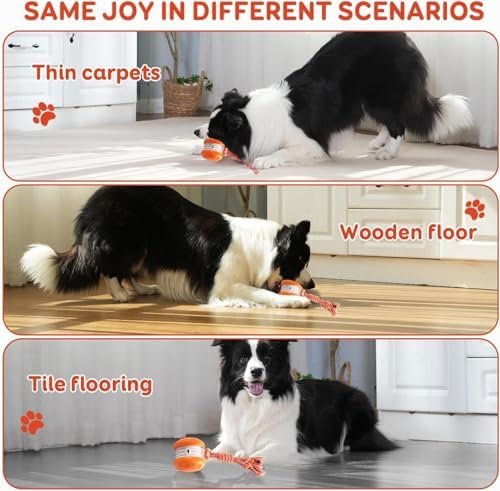
The QGI is two wheels with a rope through the middle, and its whole design is unpredictable travel. Owners describe it changing direction, crossing rooms, and keeping a dog moving until the dog is genuinely tired — one calls it the only toy that has ever worn their dog out. The most-agreed-with positive review describes the real use case plainly: switch it on so the dog is busy while you get on with something.
If your dog’s idea of a good time is running after something, start here. It’s also the one with the largest sample and the lowest low-star rate of the three, which is a statistics reason rather than a product one, but it counts.
Holders and teething puppies: the seagi
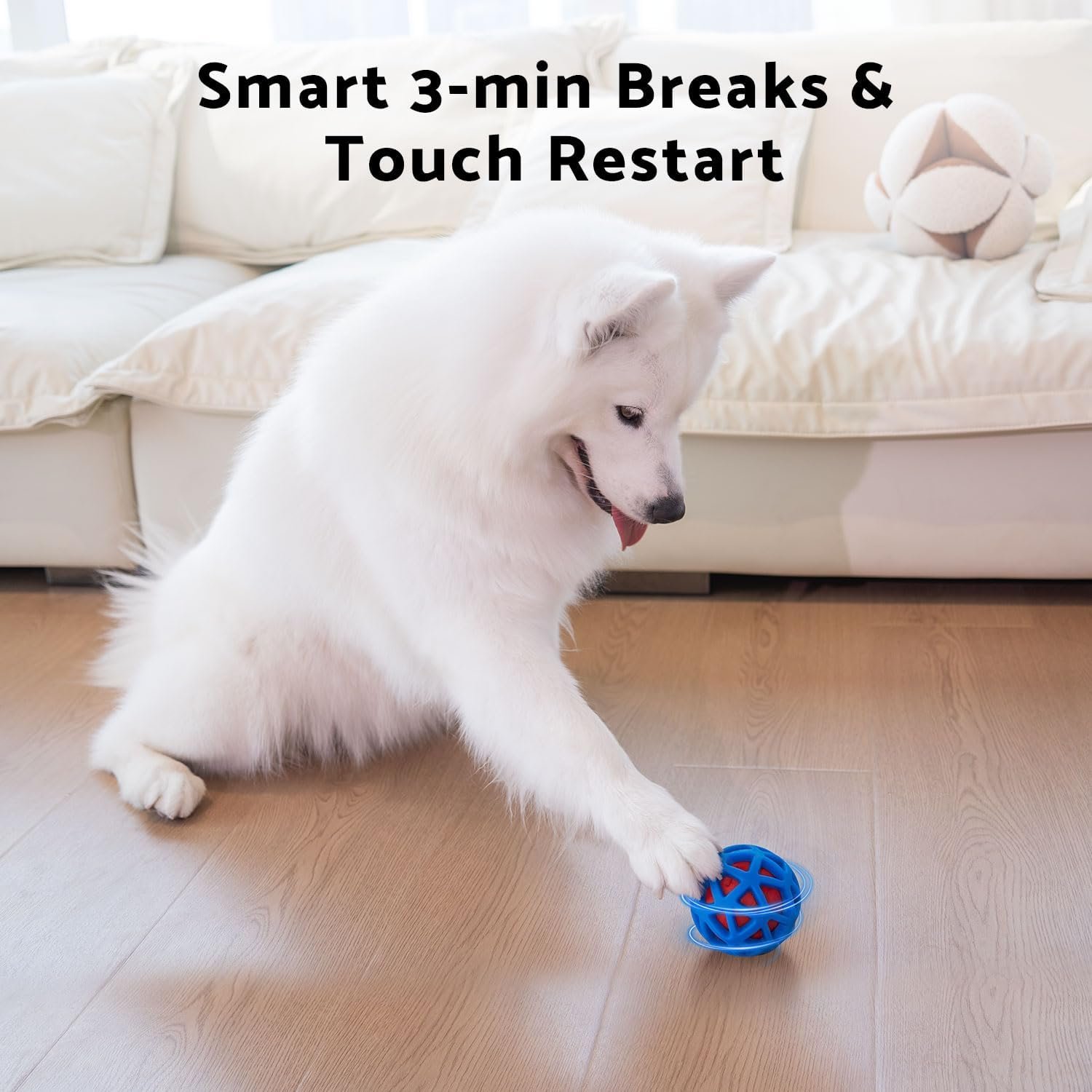
The seagi rolls too, but the reviews that stand out are about its vibrating mode and the natural-rubber cage around the ball. Owners describe puppies chewing on it while it shakes, and more than one says the vibration seems to calm teething gums. A four-month-old, seven-pound puppy chews it daily with no marks, according to one owner.
If your dog carries toys around rather than chasing them, or is teething, this is the one built for that. With a caveat below about the cage.
Pullers and shakers: the Qraxond octopus
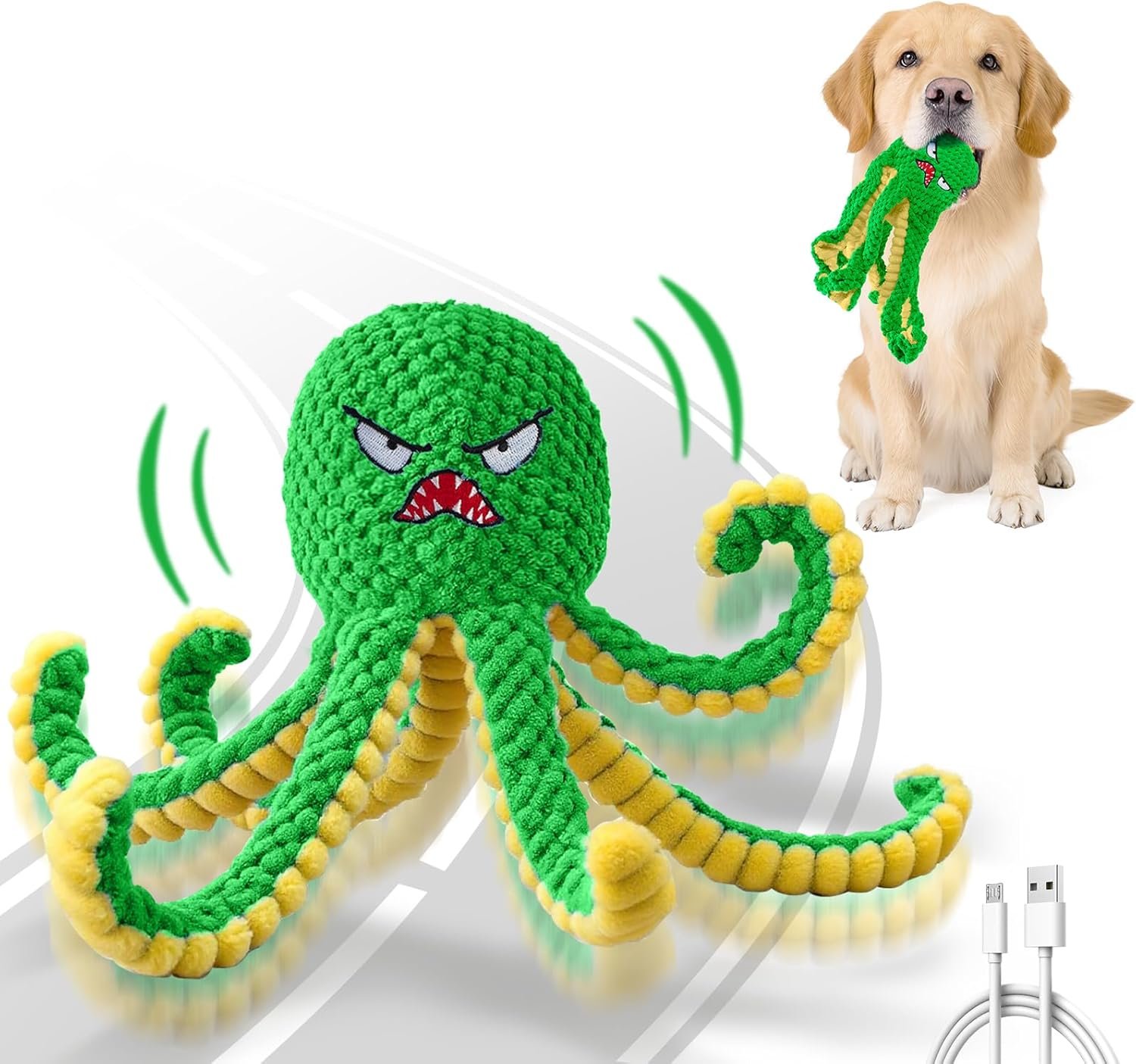
The octopus is the only one of the three with something to grab. Owners credit the legs for holding attention longer than a plain ball, and several use it for tug as well as chase. The squeak matters too; movement plus sound is what several owners say got their dog interested in the first place.
If your dog grabs, shakes and pulls, this is the one with a shape for it. Just set your expectations from the customer photographs rather than the product shots — the legs curl inward in real life, and several owners found them shorter than they’d pictured.
Does your dog chew?
Then none of them, and all three listings say so. The interesting part is that the warning means something different on each one, and what actually breaks is different too.
On the QGI the warning is in small type under a headline about safety. Chewers strip the soft top section, then the rope, then start on the housing where the battery sits. The box includes a spare rope and a spare wheel, which helps with wear but not with a dog that’s determined.
On the octopus the warning is in large red type, and the part that goes is the plush cover, held with velcro. The cover is sold separately, and at least one five-star owner buys them in bulk and treats them as consumables. Whether that is acceptable is your call, but it turns “my dog destroyed it” into an ongoing cost rather than a dead toy.
On the seagi the warning is in the listing image header, and the part that goes is the rubber cage. Here the line does not hold: the dogs removing it in the low-star reviews include a Pomeranian, a Yorkie, a dachshund and two seven-pound puppies, and two of those owners specifically say their dog is not a chewer. A spare cage comes in the box and more are sold separately, and the ball runs fine without one — but if the cage staying on is the point, this is the weakest of the three. I’ve gone through the low-star reviews on all three in a separate post.
The honest summary: for a determined chewer, the octopus and the seagi at least have a cheap replaceable outer part. The QGI’s spares cover wear rather than the housing, and it’s the one where chewing heads toward the battery.
Is your dog nervous?
Some dogs find a self-propelled object frightening. On all three listings I found owners whose dog was scared of it at first — some returned it, some report the dog coming round. What differs is what each product offers for that dog.
The octopus has a slow mode that’s described as trembling rather than bouncing, and it exists specifically for timid dogs. Several owners report it working. One reports their dog still preferring the toy with the motor switched off entirely.
The seagi has a listing tip I haven’t seen elsewhere: put a long treat inside the cage for the first few minutes, then swap in the ball. I can’t verify it works, but it’s a different idea from the usual advice. One owner reports fear turning into hours of play, though not necessarily by this method.
The QGI publishes a four-step introduction routine in its listing images and has a low speed setting. One owner followed exactly that routine with a four-month-old puppy and the puppy still hid under the bed. Another household has three dogs: two love it, one is afraid.
Across all three, the advice happy owners give is the same: introduce it switched off, let the dog investigate, and turn it on later. None of the three has solved this problem. The octopus has done the most to design for it.
What’s on your floor?
The QGI listing says thin carpet, wood and tile. The seagi listing says tile, hardwood and short carpet, and warns that rolling mode struggles on thick rugs. The rubber cage on the seagi also does a second job here: one owner bought it specifically so their dog could play with a motorised ball on hardwood without the ball marking the floor.
I didn’t find floor-specific reports for the octopus in the reviews I read, so I can’t tell you. The plush cover presumably softens it, but that’s an assumption rather than something an owner said.
Charging, batteries and noise
All three are USB rechargeable, and all three have a charging complaint pattern in the low-star reviews. This is the one thing to test hard in the first week on whichever you choose.
QGI: USB-C. The recurring complaint is a charge that holds well at first and then stops, over weeks. A few owners also report wheels that stopped turning.
Octopus: the motor ball twists open to charge. Owners report units refusing a charge at around two months, and a related fault where the ball won’t stay twisted shut afterwards.
seagi: a sealed one-piece ball with the port under a silicone plug, which one owner specifically praises because a chewer can’t ruin a seam that isn’t there. The plug is the vulnerable part instead — two low-star owners describe dogs popping it off. One reports the unit refusing to charge after about five cycles.
Noise is mixed on all three and does not separate them. The most common report on each is “some noise, tolerable in the same room”, with a minority who found it too much. The seagi’s hard ball on a hard floor probably makes the most, but that’s inference rather than something I can show you from reviews.
Why they all sit at 3.9 to 4.2, for different reasons
Ratings this close look like the same product with different shells. They aren’t, and the low-star reviews explain the gap on each.
The QGI loses stars to two things: dogs it doesn’t suit (chewers, nervous dogs) and a battery fault. The first is not the product’s fault; the second is.
The octopus loses stars to charging faults and to the gap between its photographs and the toy that arrives. Both are the product’s fault, though the second is fixable by looking at customer photos before buying.
The seagi loses stars to the cage. That is a design weakness, and the warning on the listing does not cover the dogs doing the damage.
And all three lose stars to the same thing no listing can fix: the dog ignored it. A schnauzer that won’t look at the ball. Two dogs that walked past the octopus. A rat terrier that doesn’t like it at all. That sets a floor on the one-star rate for the whole category, and it is the main reason these toys rate lower than, say, a lamp.
Best interactive dog toy: the short version
Chaser, no chewing, high energy: the QGI. Largest sample, lowest low-star rate, and the clearest “it tired my dog out” reviews.
Teething puppy, or a dog that carries toys: the seagi. Vibration and rubber to bite. Accept that the cage may not last and that the ball works without it.
Grabber, tugger, or a nervous dog: the octopus. Legs, squeak, and a slow mode designed for the cautious. Budget for replacement covers if your dog chews.
Serious chewer: none of them. The two with cheap replaceable covers are the least bad options; the QGI is the one where chewing reaches the battery.
Don’t know yet: the QGI, on the strength of the numbers rather than anything specific. Keep the receipt for the first week on any of them, and test the charge cycle before the return window closes.
The reviews behind this
A selection of the reviews the decisions above rest on — rating, month and helpful-vote count, so you can find them on each listing. No names and no quoted text. The full tables are in the individual reviews.
| Listing | Rating | Posted | Votes | What it reports |
|---|---|---|---|---|
| QGI | 5 star | Aug 2026 | 3 | Keeps the dog busy while the owner gets things done |
| QGI | 5 star | Jul 2026 | 0 | The only toy that has genuinely tired this dog out |
| QGI | 3 star | Aug 2026 | 0 | Followed the introduction routine; puppy still hid under the bed |
| QGI | 1 star | Jul 2026 | 0 | Wheel torn off, then chewing toward the battery housing |
| QGI | 3 star | Jun 2026 | 0 | Fun, but the charge stopped holding |
| Qraxond | 5 star | Aug 2026 | 1 | Shell wears through in about two months; buys replacements in bulk |
| Qraxond | 5 star | Aug 2026 | 0 | Octopus shape makes it easy to grab and pull for tug |
| Qraxond | 3 star | Aug 2026 | 0 | Legs curl toward the body rather than spreading as in the photo |
| Qraxond | 2 star | Aug 2026 | 2 | Two months in, will not take a charge |
| Qraxond | 3 star | Aug 2026 | 0 | Bouncing frightened this dog; preferred it with the motor out |
| seagi | 5 star | Mar 2026 | 1 | Seven-pound teething puppy chews it daily with no marks |
| seagi | 5 star | Feb 2026 | 1 | One-piece design means no seam for a chewer to ruin |
| seagi | 2 star | Jul 2026 | 1 | Bought for hardwood floors; non-chewer Pomeranian tore the cage in five minutes |
| seagi | 1 star | Feb 2026 | 2 | Seven-pound teething puppy removed the cage and the charging plug within minutes |
| seagi | 3 star | Mar 2026 | 0 | Schnauzer will not look at it |
Common questions
Which one is most durable?
For a non-chewing dog, the reviews don’t separate them much. For a chewing dog, none of them, but the octopus and seagi have replaceable covers and the QGI doesn’t.
Which is best for a small dog?
Owners of small dogs appear in the positive reviews of all three. The seagi’s vibration was too strong for a couple of five-pound dogs, and its cage failed on several small ones. The octopus and QGI have small-dog success stories without that pattern.
Which is quietest?
I can’t rank them. On each one, most owners describe the noise as tolerable and a minority disagree. Nothing in the reviews I read puts one clearly ahead.
Can I just buy the highest-rated?
That’s the QGI at 4.2, and if your dog chases and doesn’t chew, it’s a reasonable default. But the 0.3-star gap is smaller than the difference between a dog that chases and a dog that holds. Match the toy to the dog first.
Star percentages are Amazon’s published figures at the time of writing and will drift as new ratings arrive. Patterns above are summarised in my own words from samples of the written reviews Amazon surfaces on each listing, which are smaller than each listing’s full review count and much smaller than its total ratings. Product images are from the manufacturers’ listings. Specifications, pricing and availability change; check the listings for current details.