How this was researched: I have not used any of these products myself. I went through the written customer reviews Amazon surfaces on three separate listings — the low-star ones in full, plus the four and five star ones — and summarised the patterns in my own words. That is a subset of each listing’s total rating count, since most ratings carry no written review. No opinions here are sponsored. The Amazon links on this page are affiliate links: as an Amazon Associate I earn from qualifying purchases, at no extra cost to you.
Astronaut galaxy projector not working? The short answer is that the cause is usually physical rather than electrical. The head lifts off the body, the body sits on a small base, and neither joint holds under a knock. Owners across three different brands describe the same sequence — the unit falls, and some time later it stops working properly. Securing the base prevents most of it.
The same complaint, on three different products
I went into this expecting to write about one lamp. What I found instead was that three unrelated brands produce the same failure, described in almost identical language by their owners.
On the first listing, a two-star owner worked through the causation himself. His unit ended up with only the green laser working, and he was clear that he did not think it would have broken if it had not fallen off the base onto the floor so many times. The base, in his description, never held the body securely in the first place.
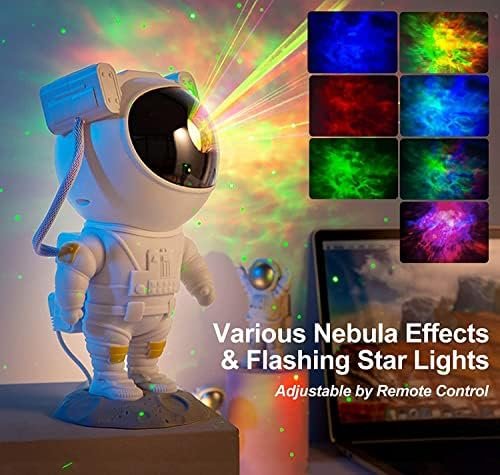
On a second listing from a different brand, a four-star owner — someone who otherwise liked the lamp enough to recommend it — noted that the smallest bump would either knock the astronaut over or take the head off its shoulders. Another owner of the same model reported that when it fell from a nightstand, the connector going into the backpack broke.
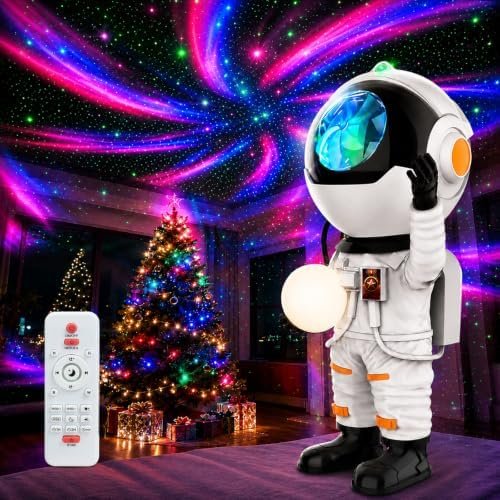
On a third listing, a three-star owner gave the most complete account. She had been enjoying hers for two months when she moved something nearby, the table shifted slightly, and the astronaut went off its base onto the floor. The head would no longer magnetise back onto the body. Her conclusion was blunt: she would not buy this for a child until a stronger, more secure base existed.
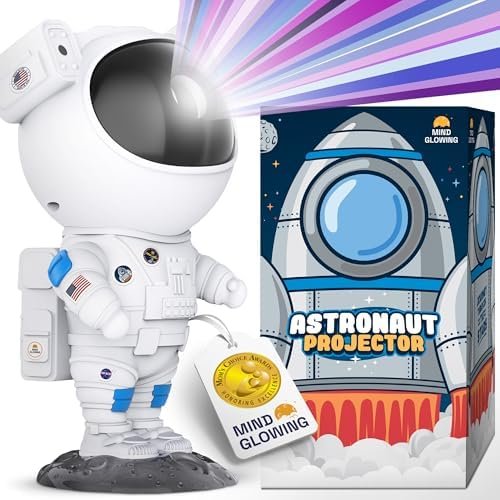
Three brands. Three price points. One failure.
Why the design does this
The head has to come off. That is not a manufacturing defect — it is the feature you paid for.
These lamps project from the visor, so aiming them means moving the head. All three models I looked at solve that the same way: the head sits on the shoulders on a magnet or a friction fit, so you can rotate it freely and tilt it towards a ceiling. A permanently fixed head would be more durable and far less useful.
Then there is the weight distribution. The head is the heaviest component because it contains the projection optics and the laser assembly. It sits at the top of a narrow body, which stands on a base roughly the size of a coaster. A lamp with its mass at the top and a small footprint is a lamp that tips.

Put those two together and you get the pattern in the reviews. A small knock tips the unit. The head, held only by a magnet, separates on the way down. Repeat that a few times and something inside stops making contact.
It is common enough that people have started publishing fixes for it:
Astronaut galaxy projector not working: what to check first
Before assuming the unit is dead, work through these in order. Several owners who reported total failure later found the problem was a connection rather than a component.
The head will not stay on, or the light is intermittent. Take the head off completely and look at the contact ring where it meets the shoulders. If the lamp has been dropped, the alignment can be slightly off, and it will sit on without actually connecting. Seat it deliberately rather than dropping it into place.
Nothing comes on at all. Check the connector at the back of the body first, not the wall adapter. On at least one model the connector at the backpack is the documented breakage point after a fall. One owner in this data set reported a completely dead unit and later updated their review: it had simply not been connecting to power properly.
Some lighting modes work and others do not. This is the pattern most likely to be genuine internal damage. The nebula layer and the star laser are separate assemblies, and owners who lost one but kept the other generally did not recover it.
If none of that helps, check your return window before you spend more time on it. Several owners in this data discovered the fault after their window had closed, and at least one reported that the manufacturer did not respond to a warranty request at all.
How to stop it happening
Three things, none of which cost anything. Each one removes a common reason for an astronaut galaxy projector not working a few months in.
Secure the base. This is the whole fix. One four-star owner solved it by taping the feet down and mentioned it almost as an afterthought. A strip of clear tape or two dots of adhesive putty under the base removes the tipping failure entirely. In these reviews the owners mentioning a year of use are not the ones describing drops. That is a pattern in a small sample rather than proof, but the two groups barely overlap.
Put it high, and back from the edge. A shelf or a dresser rather than a nightstand. Not only does this stop the knocks, it also improves what the lamp does — the projection covers more ceiling from higher up, and the star laser passes over people rather than across them at eye level.
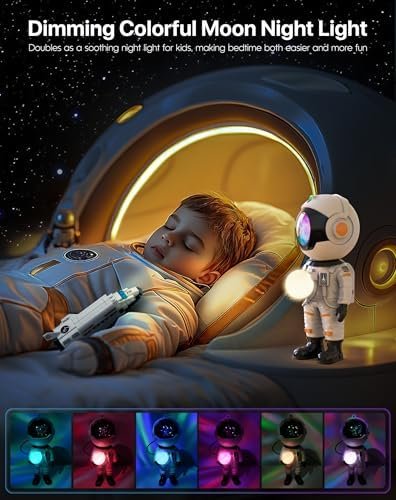
Leave slack in the cable. A taut cable is a lever. If someone walks past and catches it, the lamp comes down. Several of the falls described in these reviews sound like cable snags rather than direct knocks.
Does any model handle this better?
Barely, and the numbers say so plainly. Amazon publishes a star breakdown on every listing, and across these three the one and two star share lands at 3%, 5% and 3%. Averages of 4.6, 4.6 and 4.7. Those are the same product as far as the ratings are concerned.
What differs is the shape of the complaint, and that is the part worth knowing. On the first, easily the largest listing at over four thousand ratings, the dominant theme is the green laser sitting at eye level. On the second it is tipping and the head coming off the shoulders. On the third it is different in kind — several owners describe units that switch off within seconds of being turned on, from the first day, which is an electrical fault rather than a handling one.
Two of those three are prevented by where you put the lamp. The third is not, which is why testing it properly on day one matters more than choosing between the listings.
I will put the three side by side properly in a follow-up. For now: whichever you own or buy, tape the base.
Common questions
Why does my astronaut projector turn off after a few seconds?
This is a distinct fault from the falling-head problem and appears concentrated on particular batches rather than across the category. Owners describing it report it from the first day, using both the button and the remote. It is a return, not a fix.
Can a magnetic head be reattached after it breaks off?
Usually yes, if the fall only separated it. Clean the contact surfaces and seat the head deliberately rather than letting it drop on. If the head sits on but the lamp stays dark, the internal connector is more likely damaged than the magnet.
Are these projectors safe for a child’s room?
The tipping issue is worth weighing. One reviewer specifically said she would not buy one for a child until the base was redesigned, having broken hers as an adult. Secured to a high shelf and out of reach, the risk is much lower than on a bedside table.
How long should one of these last?
Owners who secured the unit report a year or more of nightly use with no decline in brightness. The failures clustered in these reviews are almost all physical, and almost all happened to lamps that had been knocked over at least once.
Astronaut galaxy projectors — the series
- Is the astronaut galaxy projector worth it?
- Why they stop working, and how to prevent it — you are here
- Which of the three to actually buy
This article summarises verified customer reviews across three separate product listings in my own words rather than reproducing them. Product images are from the manufacturers’ listings. Availability and specifications change; check the listings for current details.