How this was researched: I haven’t used any of these feeders, and I don’t have a cat. I read about ninety written customer reviews across three automatic cat feeder listings on Amazon — mostly from the low end, roughly forty each for VOLUAS and PAPIFEED, and the much thinner set Amazon surfaced for PETLIBRO — and sorted the complaints by type and by machine, in my own words, the same way as every review on this site. That’s a slice rather than a census: each listing has far more low-star reviews than I read, and most ratings carry no written review at all. Star percentages are Amazon’s published figures. Nothing here is sponsored. The Amazon links on this page are affiliate links: as an Amazon Associate I earn from qualifying purchases, at no extra cost to you.
Three automatic cat feeders. One is a timer with a hopper. Two connect to your phone. Between them they carry about 27,000 ratings, and between 9% and 18% of those ratings are one or two stars.
I expected the automatic cat feeder problems to split neatly along that line: the dumb one jams, the smart ones lose Wi-Fi. Some of that is there. But the complaint that runs through all three listings is the same one, and it’s the only one that matters if you’re buying a feeder so you can leave the house.
The meal didn’t come, and nothing told anyone.
| Listing | Ratings | Average | 1–2 star | Phone app | |
|---|---|---|---|---|---|
| VOLUAS 4 L | 12,448 | 4.4 | 9% | No | Amazon |
| PETLIBRO Granary 5 L | 10,249 | 4.1 | 18% | Yes, 2.4 and 5 GHz | Amazon |
| PAPIFEED 6 L | 4,327 | 4.3 | 12% | Yes, 2.4 GHz only | Amazon |
The meal that didn’t come, and who found out
Of all the automatic cat feeder problems in this sample, this is the one I’d weigh first. Every feeder here dispensed on schedule for most owners most of the time. The high-star reviews are full of cats who now sit by the machine instead of on the owner’s chest at 5 a.m. The question the low-star reviews answer is what happens when it doesn’t.
VOLUAS has no way to tell you. There’s no app, so a missed meal is a missed meal until a human notices. In the reviews I read for the VOLUAS review, one owner with three units over a year reports one of them silently skipping breakfast and lunch while still serving dinner. Another caught about five failures in four months on a home camera, and says smaller kibble didn’t help. A third reports the unit stopping every so often since June and needing a dozen replugs to revive. None of these owners was told by the machine. They found out from the camera, from the bowl, or from the cat.
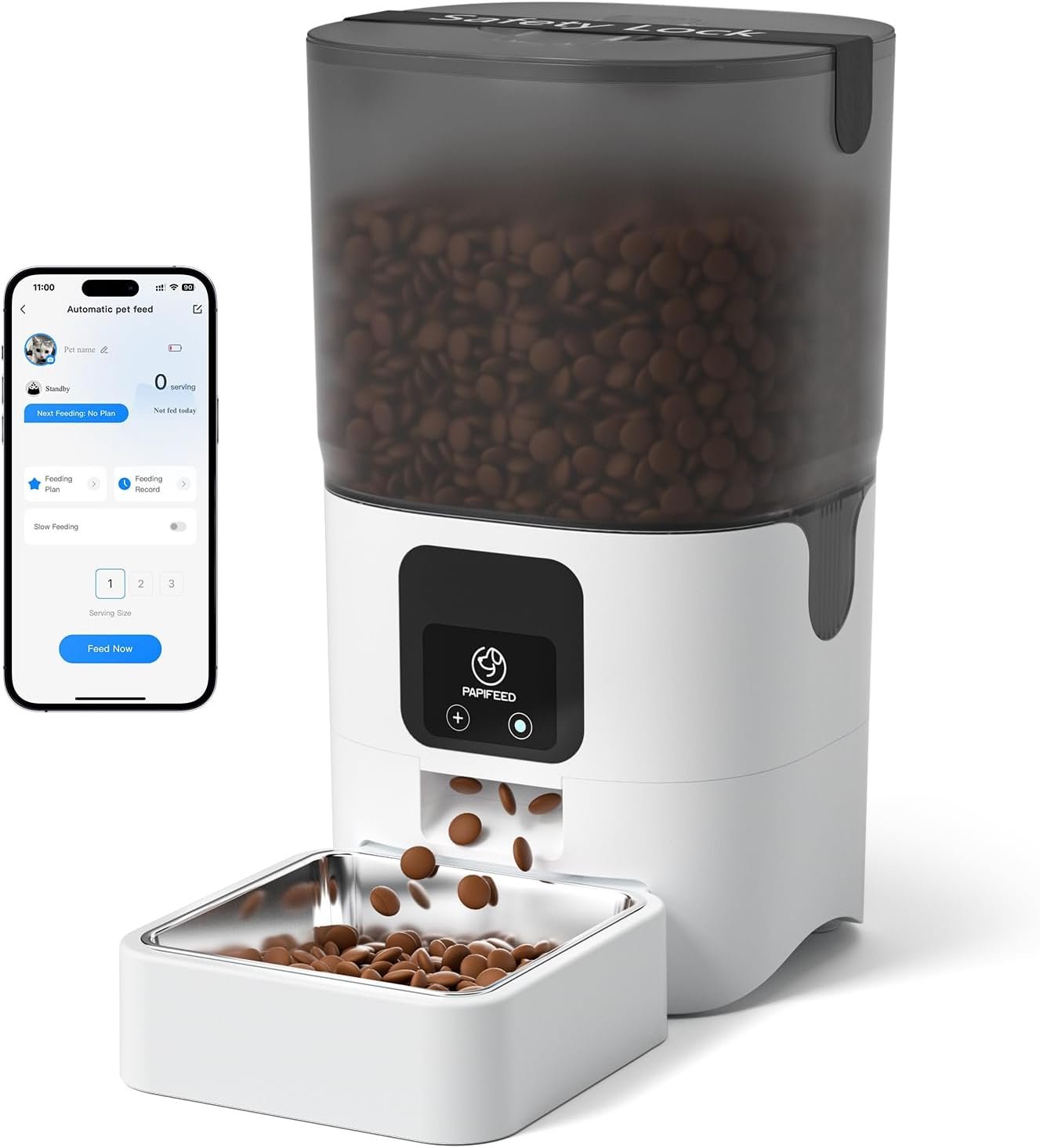
PAPIFEED has a feeding record, and the record can be wrong. A three-star review from July reports the feeder skipping meals while the history showed them distributed, alongside disconnection alerts for a unit that was in fact online; the owner works from home and keeps an eye on it, and says so with some relief. A July one-star owner had two good months and then a feeder that stopped feeding without warning. A December owner was away when the app auto-updated and the device quit, and came home to pets they describe as nearly starved. Another July reviewer says that after an app update the feeder shows offline whenever they leave the house, and no food comes out. On the other side, a four-vote five-star owner reports the one failure they’ve had, a cord knocked out of the wall, produced a failure notification in the app. So the app can report a missed meal. In my reading, it does that when the machine knows it missed, and the July owner’s history is the case where it didn’t.
A log entry is the machine’s report of what it meant to do. It’s not a sensor in the bowl. As far as I can tell from the listings and the reviews, none of the three feeders has one, and a four-star PETLIBRO owner says so outright.
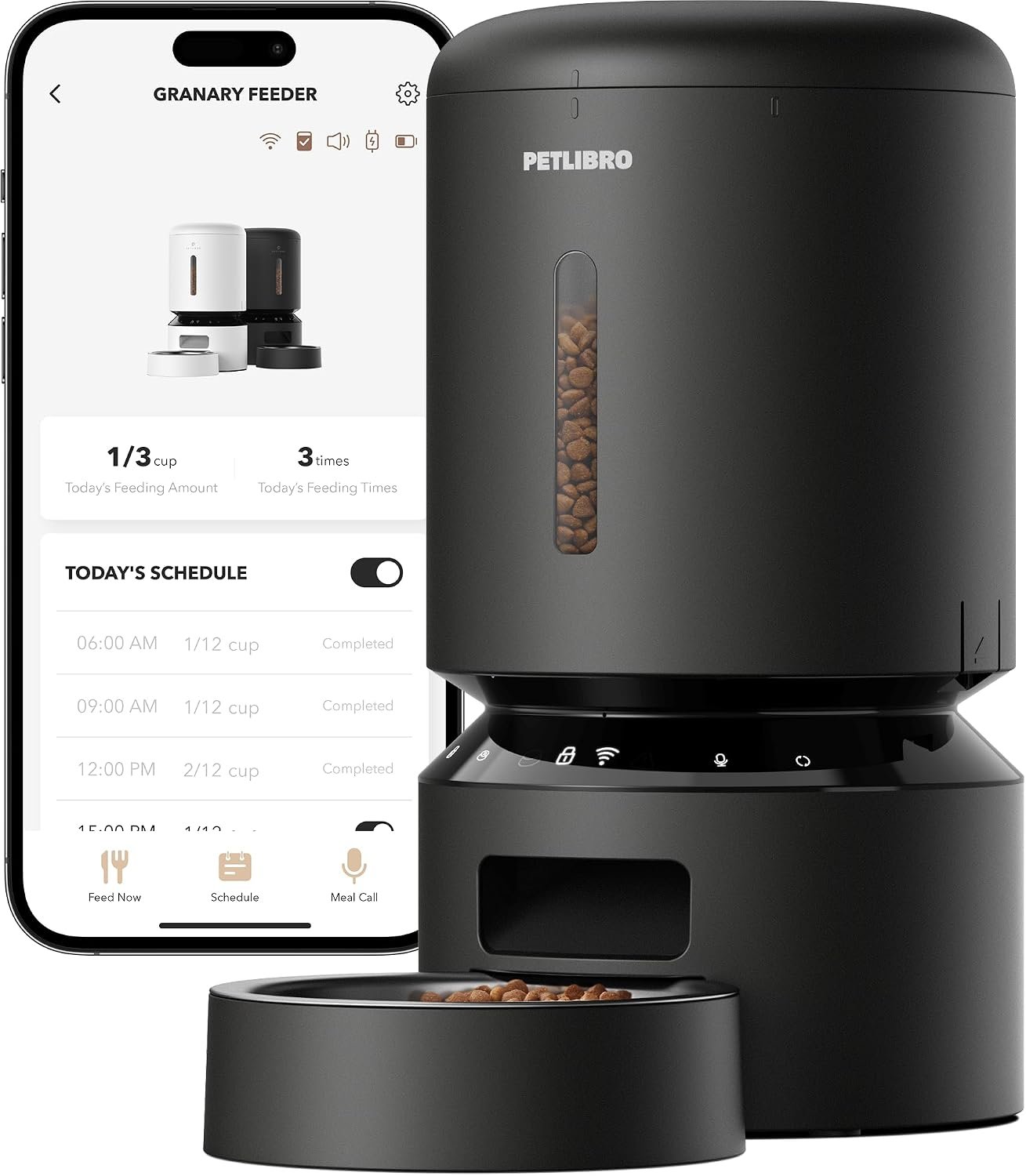
PETLIBRO sends the most alerts, and its worst failures are the ones alerts can’t cover. Owners with 183 and 22 helpful votes praise the notifications: low food, a jam at the outlet, the desiccant bag, the unit going offline. An infrared sensor at the chute is on the listing, and jam alerts do fire, according to the 46-vote reviewer, whose kibble jammed exactly once. So the app knows a lot. What it can’t know is that the machine has died. That same 46-vote review was rewritten a few months later to one star: the feeder completely stopped, and a month of customer service ended with an offer to send parts. A five-vote owner from June says theirs stopped at six months, wouldn’t rejoin Wi-Fi, and the backup batteries didn’t take over either; the cat went without food for a day or two before they realized. An August owner returned a four-day-old unit that skipped the first meal of the day and showed “Requested Time Out” in the app.
Then there’s the failure that isn’t the machine’s at all. A four-star owner whose feeder ran flawlessly for two years reports it dropping offline every three minutes on August 12 this year, and updates the next day: PETLIBRO’s servers had gone down and taken every owner’s connection with them. Two years of reliability, and one afternoon where nobody’s feeder could be reached. A feeder that depends on the cloud has the cloud’s uptime.
The portion is a count, not a weight
All three feeders let you set a number. On VOLUAS it’s portions of roughly 6–7 g by the listing; on PETLIBRO it’s twelfths of a cup; on PAPIFEED it’s one to twelve portions per meal, and the listing’s bullet points don’t say what a portion weighs. In each case the number sets how far a rotor turns, and what falls out depends on your kibble.
The VOLUAS reviews disagree with each other by a factor of three: one owner weighed three portions at 19 g, another got five to ten pieces when a quarter cup was needed, two say the wheel dispenses the same amount whatever the setting. On PETLIBRO, a three-star owner with dense kibble got 9–12 g at the smallest setting, about double what their cat eats, and switched to a different brand that meters smaller; a 183-vote five-star owner found the twelfths accurate with their kibble. On PAPIFEED the spread is wider still. A three-star owner puts a portion at about a sixteenth of a cup and likes it that way for a small cat. The 30-vote five-star review calls the portions really small and says to measure. A five-star owner who weighed a portion of their raw-coated kibble got 67 g and built the whole day’s schedule around that number. And two low-star owners report the opposite failure: extra servings firing on scheduled feeds at about eight months in one, two or three kernels at a time in the other.
Nobody is lying. A rotor moves a fixed volume, and a portion of one kibble is not a portion of another. The fix is the same on all three and appears in the high-star reviews of all three: dispense a portion by hand on day one, weigh it, and do the arithmetic from your own number, not the listing’s.
Cats versus the machine
This is where the three designs separate, and it’s not the app that separates them.
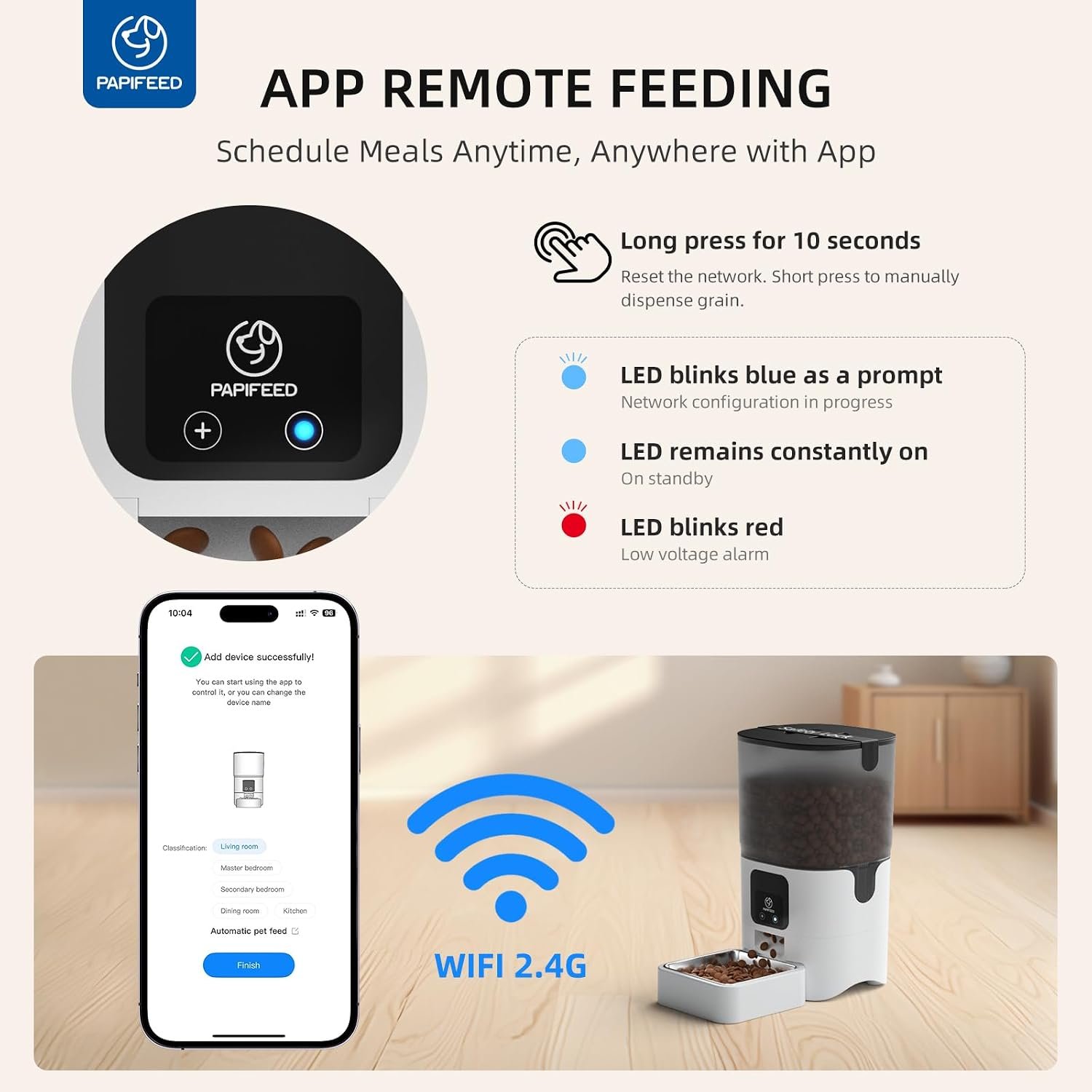
PAPIFEED has a feed button on the front, and the cats found it. The listing shows it: a short press dispenses a portion by hand. A 22-vote three-star review reports a cat nosing that button within minutes of setup, and five more times across three units since; the owner turned all three sideways and asks for a cover or an app setting to disable it. A 10-vote four-star owner, also running three units, checked the feed history and found one cat logging eight to twelve meals a day against three for the others, fixed it with a washer duct-taped over the button, and then watched the same cat learn that rubbing against the unit shook a few kernels loose from what the owner describes as misaligned fins in the rotor. The lid is held by a Velcro strap. A December three-star owner’s dog opened it with the strap on and with baby cabinet locks added, and recommends a screw-on lid instead. In the strap’s favour, a June five-star owner keeps two units outdoors and says raccoons dragged one several feet without getting in.
VOLUAS gets knocked over and unlidded. Three low-star reviews from this summer: cats knocked it over three times and ate everything, a cat removes the lid, an orange cat has broken in several times. Owners who keep it outside report raccoons learning to reach in and spin the wheel. Two high-star reviewers solved it by putting the feeder inside a cage or up on a box.
PETLIBRO, in the reviews I read, had no break-in complaints. The listing shows a twist-lock lid, a silicone seal and a rotor shaped to block a paw, and the one comment I found on the lid was a five-star owner annoyed at how much spinning it takes to get the tabs to drop. That’s a thin sample, so I won’t call it cat-proof. But it’s the only one of the three where nobody in my reading described a cat getting into the hopper, and its buttons are touch-sensitive and come locked.
Wi-Fi, apps and the things you pay for later
The two app feeders each have a set of automatic cat feeder problems that the timer doesn’t, and they’re different sets.
PAPIFEED changed apps, and repeat buyers got caught. This is the loudest theme in the PAPIFEED low-star reviews from the past year and it comes from the brand’s happiest customers. Four separate owners bought a second unit because the first one had been good, and found the new one wouldn’t connect the way the old one did. Three of them name the cause: the old app is Smart Life, the new one is called Smartlyn, and the two don’t talk to each other. Another reviewer notes Smartlyn had three reviews in the store when they looked, and two Spanish-language reviews call it a Chinese app, one saying it displayed in Chinese. The result is two feeders on two apps with two accounts. Three more owners couldn’t find the app in the App Store at all, one couldn’t get a verification code and points out there’s no way to run the feeder without a phone, and one in Argentina found the app wasn’t available in their country. A May one-star review says a monthly payment is required to use it; I found no other review in my sample confirming that, and neither the 30-vote five-star owner nor the two three-unit owners mention one, so I’d treat it as one report rather than a pattern. The Wi-Fi is 2.4 GHz only, and the 22-vote reviewer says the app grabbed the phone’s 5 GHz network and wouldn’t let them choose. The 30-vote owner adds a detail the listing doesn’t: theirs wouldn’t hold a connection at all until backup batteries were fitted, plugged in or not. Another owner reports those backup batteries draining while the unit was on mains power.
PETLIBRO’s app is polished and pushy. Three separate reviewers, five, four and three stars, mention promotional content in the app: prompts to buy other PETLIBRO products, a paid tracking tier offered at setup. All three say it’s ignorable and none says they pay for anything. The recurring cost is the desiccant bag, which the app nags you to replace every fourteen days and which the 183-vote owner prices at $15.99 for four. A May one-star review describes a button-lock setting that re-enables itself and can’t be turned off on battery power, so a power cut leaves the feeder neither feeding on schedule nor able to be fed by hand. An August two-star owner watched theirs bounce between firmware versions for three days before it missed a meal.
VOLUAS has none of this because it has nothing to update. Its app problems are that there’s no app: a three-star owner whose unit drifted an hour late after a year had no way to know except by watching, and nobody gets a low-food warning.
How early they die
The timelines are worth lining up because they’re shorter than the price suggests.
PAPIFEED: dead inside ninety days, seller not answering. Dead at four months with the gears clicking and the wheel not turning. Dead at five months, won’t run on batteries or the adapter. Stopped dispensing fully at eight months with nothing blocking it. Under a year and constantly being fixed. Bought May 2025, dead by August 2026 and past the thirty-day window. Two owners at the two-year mark report units that still run but can no longer hold Wi-Fi. PETLIBRO: dead at six months with Wi-Fi unrecoverable. Dead after a few months in the 46-vote review. A Canadian owner’s motor seized at six months, and PETLIBRO sent a replacement base after a video. VOLUAS: dead after one day, motor binding at about a year, failed at eighteen months just past warranty, mains side dead at two and three-quarter years with batteries still working.
Warranty terms as reported by owners: one year on VOLUAS, per the owner who missed it by six months. I didn’t see a term stated for PETLIBRO, only that support asked for a video before sending parts. For PAPIFEED I didn’t see a warranty mentioned at all in the reviews I read; what I did see was the listing itself carrying Amazon’s “frequently returned item” notice, and two reviewers who say the seller’s phone number and email didn’t reach anyone.
Automatic cat feeder problems: the first-week checklist
The low-star reviews across all three listings reduce to a short list of things owners wish they’d done before the first trip away.
Weigh a portion. Hand-dispense one, put it on a kitchen scale, and set the schedule from that number. This one step would have caught most of the portion complaints on all three machines.
Watch it miss. Run the schedule for a week while you’re home. The VOLUAS owner with the camera and the PAPIFEED owner who works from home both found out the same way, by being there. Don’t make the first unattended week the test.
Decide what “told” means to you. If a phone alert for jams and low food is worth a subscription-free app that shows promotions, PETLIBRO is built for that. If you’d rather have no app than an app that might change, VOLUAS is the honest version of that trade. PAPIFEED sits in between, and its app has already changed once under its owners’ feet.
Test the cat. Leave the feeder loaded and unattended for a day and see whether the cat finds the button or the lid. On PAPIFEED the reviews suggest a curious cat will find the button. On VOLUAS it may tip it. The washer, the sideways turn and the elevated box are owner fixes, not features.
Pull the plug. With batteries in, unplug the feeder at a scheduled time and see whether it feeds. Two PETLIBRO owners report backup batteries that didn’t take over, and one PAPIFEED owner reports a unit that needed batteries fitted just to stay on Wi-Fi.
If you want the single-machine versions of these automatic cat feeder problems, the VOLUAS review covers the timer in detail, and the rest of the pet reviews include a sister piece on automatic ball launcher problems, where the pattern was much the same: the failure that matters is the one the listing doesn’t mention.
The reviews behind this
Rating, month and helpful-vote count, so you can find them on each listing yourself. No names and no quoted text — these are summaries in my own words. The VOLUAS rows are the subset cited above; the fuller table is in the VOLUAS review.
| Listing | Rating | Posted | Votes | What it reports |
|---|---|---|---|---|
| PETLIBRO | 5 star | May 2024 | 183 | Twelfths accurate with their kibble; alerts for bowl-full and desiccant; $15.99 for four bags every two weeks |
| PETLIBRO | 1 star | Sep 2025 | 46 | Five stars for two months, then dead after a few months; AI support, then a human, then an offer of parts |
| PETLIBRO | 5 star | Jun 2026 | 30 | Lid needs a lot of spinning to lock; app promotes other products once; speaker poor |
| PETLIBRO | 5 star | Aug 2024 | 22 | Jam and low-food alerts helpful; desiccant only lasts 14 days |
| PETLIBRO | 1 star | Jun 2026 | 5 | Dead at six months, Wi-Fi unrecoverable, batteries didn’t take over; pet unfed a day or two |
| PETLIBRO | 4 star | Aug 2026 | 3 | Two years flawless; dropped offline Aug 12 during a server outage; back next day |
| PETLIBRO | 4 star | May 2026 | 3 | No sensor in the bowl; ads at setup; paid tracking optional; touch buttons come locked |
| PETLIBRO | 3 star | Sep 2026 | 1 | Dense kibble gave 9–12 g at the smallest setting; switched brands |
| PETLIBRO | 2 star | Aug 2026 | 0 | Firmware bouncing for three days; skipped the first meal; “Requested Time Out” |
| PETLIBRO | 1 star | May 2026 | 0 | Button lock re-enables itself; can’t feed by hand on battery; depth 14.25 in, not 12.99 |
| PETLIBRO | 5 star | Feb 2025 | — | Canada: motor seized at six months; replacement base sent after a video |
| PAPIFEED | 5 star | Nov 2022 | 30 | Wouldn’t stay connected until backup batteries were fitted; portions really small, measure them; Smart Life app |
| PAPIFEED | 3 star | Mar 2024 | 22 | Cat nosed the front feed button within minutes; app wouldn’t let them pick a 2.4 GHz network; Velcro strap holds |
| PAPIFEED | 4 star | Oct 2025 | 10 | Three units; one cat logged 8–12 meals a day via the button; washer taped over it; misaligned fins drop kernels when nudged |
| PAPIFEED | 5 star | Mar 2026 | 4 | Weighed a portion at 67 g with their kibble; cord knocked out once and the app flagged the failure |
| PAPIFEED | 1 star | Jun 2026 | 3 | Second unit uses a different app from the first; dead at five months on batteries and adapter |
| PAPIFEED | 5 star | Jun 2026 | 1 | Two units outdoors since December; raccoons dragged one, strap held |
| PAPIFEED | 1 star | Feb 2026 | 1 | Locks up during Wi-Fi setup; instructions unreadably small |
| PAPIFEED | 1 star | Jan 2026 | 1 | Verification code never arrived; no way to run it without a phone |
| PAPIFEED | 1 star | Nov 2025 | 1 | Two earlier units loved; new one and its replacement wouldn’t connect |
| PAPIFEED | 1 star | Aug 2026 | 0 | Bought May 2025, dead by August 2026; past the 30-day window |
| PAPIFEED | 1 star | Aug 2026 | 0 | Showed offline, wouldn’t re-add; dead under a year |
| PAPIFEED | 1 star | Jul 2026 | 0 | Second unit requires the Smartlyn app; first still on Smart Life |
| PAPIFEED | 3 star | Jul 2026 | 0 | After an app update, shows offline away from home and no food comes out |
| PAPIFEED | 1 star | Jul 2026 | 0 | Two good months, then stopped feeding without warning |
| PAPIFEED | 3 star | Jul 2026 | 0 | Portion about 1/16 cup; false disconnect alerts; skips meals while history says distributed |
| PAPIFEED | 1 star | Jun 2026 | 0 | Backup batteries drain while plugged in |
| PAPIFEED | 2 star | May 2026 | 0 | 2024 unit on Smart Life, 2026 unit on Smartlyn; incompatible |
| PAPIFEED | 1 star | May 2026 | 0 | Says a monthly payment is required; not stated in the listing |
| PAPIFEED | 1 star | May 2026 | 0 | App not in the App Store |
| PAPIFEED | 1 star | May 2026 | 0 | Argentina: app not available there |
| PAPIFEED | 1 star | Apr 2026 | 0 | Eight months, then not dispensing fully; nothing blocking |
| PAPIFEED | 1 star | Apr 2026 | 0 | Two or three kernels at a time; locked out of the app |
| PAPIFEED | 1 star | Mar 2026 | 0 | Two years, then quit connecting; phone number goes to Thailand |
| PAPIFEED | 2 star | Mar 2026 | 0 | Two years, now disconnects constantly; afraid to rely on it |
| PAPIFEED | 1 star | Mar 2026 | 0 | Dead inside 90 days; seller not answering |
| PAPIFEED | 1 star | Jan 2026 | 0 | Four months; gears click, wheel doesn’t turn |
| PAPIFEED | 1 star | Dec 2025 | 0 | App auto-updated while owner was away; device quit; pets nearly starved |
| PAPIFEED | 3 star | Dec 2025 | 0 | Dog opened it past the strap and baby locks; wants a screw-on lid |
| PAPIFEED | 1 star | Nov 2025 | 0 | Requires Smartlyn, not Smart Life as advertised |
| PAPIFEED | 1 star | Nov 2025 | 0 | Under a year, constantly needing fixes |
| PAPIFEED | 2 star | Oct 2025 | 0 | Eight months, then extra servings on scheduled feeds; eats batteries |
| VOLUAS | 1 star | Jul 2026 | 1 | Three units; one silently skipped breakfast and lunch |
| VOLUAS | 1 star | Sep 2026 | 1 | About five failures in four months, seen on camera |
| VOLUAS | 2 star | Aug 2026 | 0 | Stops every so often; ten replugs to revive |
| VOLUAS | 4 star | Aug 2026 | 0 | Three portions weighed 19 g |
| VOLUAS | 1 star | Jul 2026 | 0 | Five to ten pieces when a quarter cup was needed |
| VOLUAS | 1 star | Sep 2026 | 1 | Cats knocked it over three times |
| VOLUAS | 2 star | Aug 2026 | 2 | Cat removes the lid |
| VOLUAS | 3 star | Jun 2026 | 0 | Runs an hour late after a year |
| VOLUAS | 2 star | Aug 2026 | 1 | Failed at eighteen months, past the one-year warranty |
Common questions
Which automatic cat feeder problems can an app actually prevent?
Jams at the outlet and a low hopper, if the machine has sensors for them, which PETLIBRO does. An app can’t prevent a dead motor, a dead power supply or a server outage, and in the reviews I read those are the failures that left cats unfed.
Is the no-app feeder more reliable?
Its rating is higher and its low-star share is the smallest of the three, but its misses are silent. In this sample it failed less often and told you less when it did.
Does PAPIFEED need a subscription?
One reviewer says a monthly payment is required. Nobody else in my sample, including owners running three units, mentions paying anything. I can’t confirm either way from here; check the app before you rely on it.
Will a cat get into any of these?
PAPIFEED’s front button is the most-reported route, and one dog got past its strap. VOLUAS gets tipped. In my reading, PETLIBRO had none, which is a smaller sample than the other two.
What’s the one thing to do before leaving town?
Run the machine at home for a week and weigh a portion. The owners in this piece who came home to an empty bowl were away; the ones who caught it early were home and watching.
Star percentages are Amazon’s published figures at the time of writing and will drift as new ratings arrive. Patterns above are summarised in my own words from samples of the written reviews Amazon surfaces on each listing, which are smaller than each listing’s full review count and much smaller than its total ratings. Product images are from the manufacturers’ listings. Specifications, pricing and availability change; check the listings for current details.