How this PetSafe automatic ball launcher review was made: I haven’t used this product, and I don’t have a dog. I read about forty of the written customer reviews Amazon surfaces on this listing, from across the rating range, and summarised the patterns in my own words. That’s a sample rather than a full reading, and most ratings carry no written review at all. Star percentages are Amazon’s published figures. Nothing here is sponsored. The Amazon links on this page are affiliate links: as an Amazon Associate I earn from qualifying purchases, at no extra cost to you.
3.4 stars across 2,254 ratings, with 29% at one or two. That is the lowest average of anything I’ve covered on this site, from a brand that has been making pet products for a quarter of a century.
And yet the most-voted reviews I read are five- and four-star, and they come from the same kind of household: a Malinois, a heeler, a German Shepherd, a pair of Rottweilers. Dogs whose owners talk about ball drive without irony. Read those reviews next to the one-star ones and a pattern appears that this PetSafe automatic ball launcher review is built around:
Nearly everything the unhappy owners complain about is something the obsessed-dog owners either don’t mind or actively want. The noise. The force. The sensor. The rest cycle. This machine was tuned for one kind of dog, and the rating is what happens when the other kind buys it.
What you’re buying
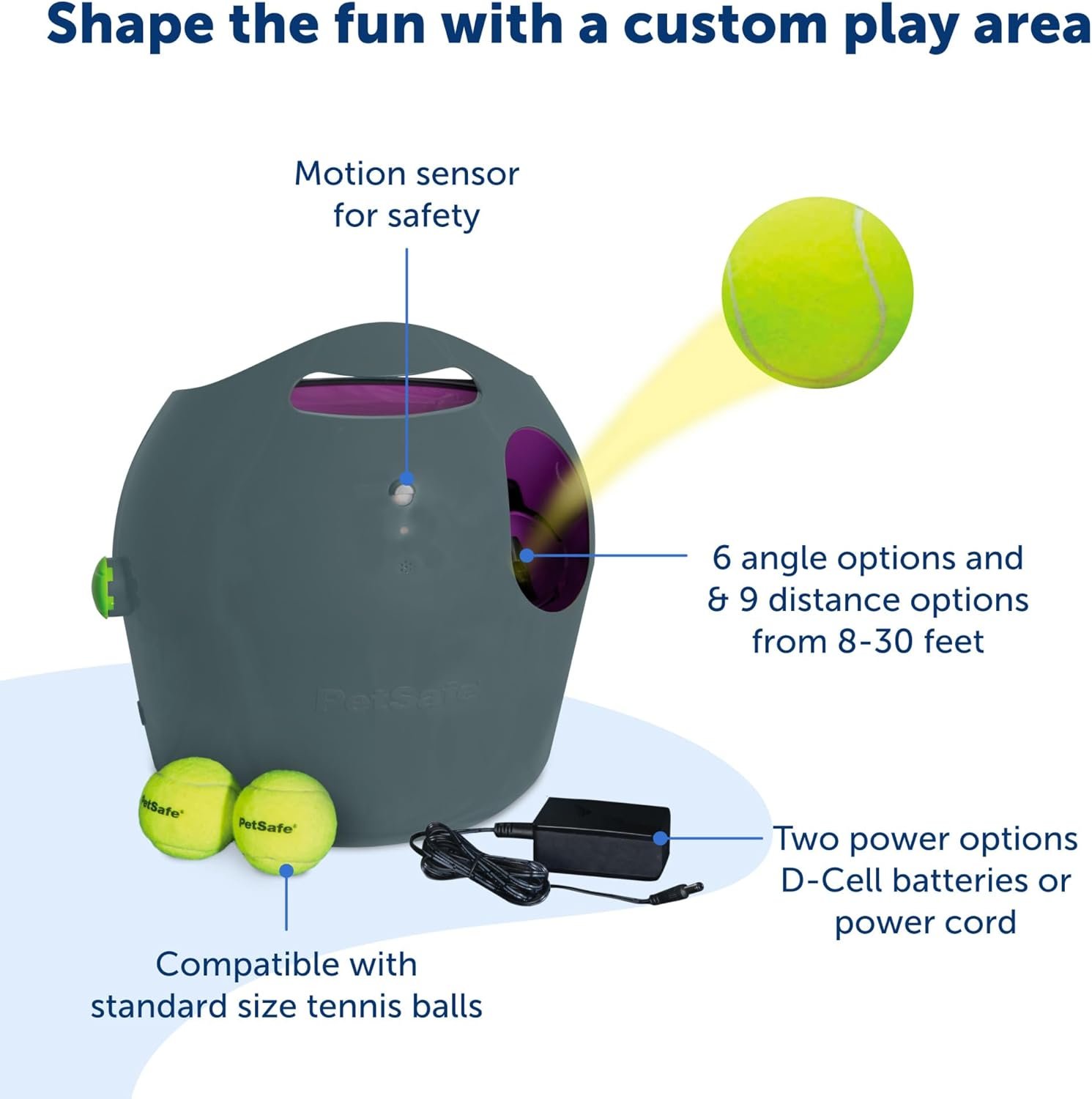
A rounded grey housing with a hopper on top, a purple launch port on the front, and two dials on the side. Nine distance settings and six angle settings, for a stated range of 8 to 30 feet. It takes standard 2.5-inch tennis balls and holds up to three at once. Power is the included mains cord or six D-cell batteries. The listing calls it waterproof.
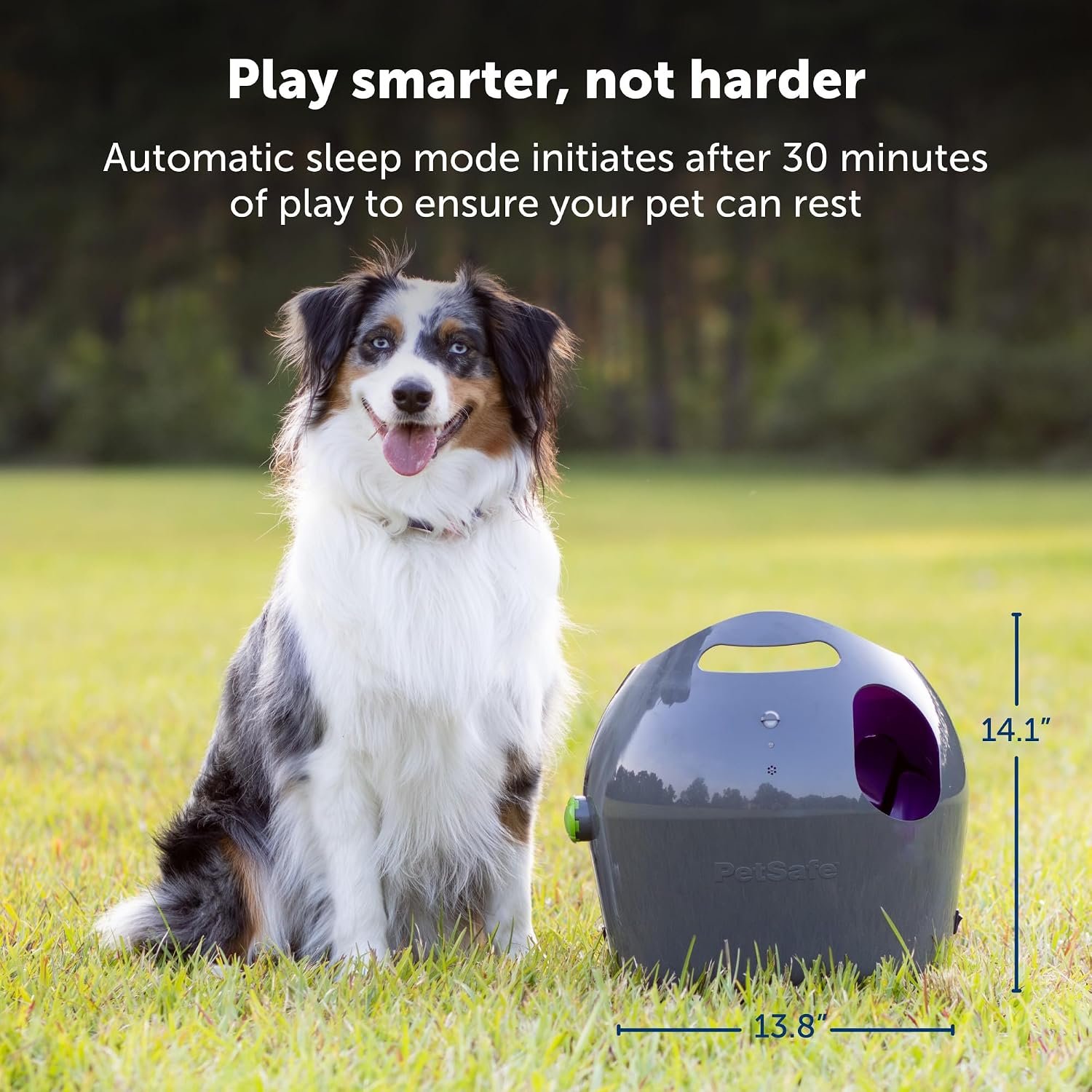
Two things set it apart from the cheaper launchers I’ve covered. A front motion sensor is meant to hold the launch when a dog or person is within seven feet of the port. And it runs in cycles: the bullet points say fifteen minutes of play then a fifteen-minute rest, though one of the listing images says sleep mode starts after thirty. The listing does not reconcile those.
Here’s what it looks like with two dogs who know the drill — a short clip from an owner’s channel with no product links anywhere in it, so I can’t vouch for anything beyond that:
The sensor, and what obsessed dogs do to it
The safety sensor is the feature that separates this from the Franklin and All For Paws launchers, and the reviews are more interesting about it than the listing is.
A five-star review with seven helpful votes comes from a heeler household two years in. The machine still works, the dog learned it quickly, and they taped over the front sensor — because the dog sits directly in front of the port waiting for the throw, and the sensor holds the launch while he’s there. The most-voted review I read, seventeen votes and four stars, is a Malinois owner who kept the sensor and reports it not always working: the dog has taken a couple of balls to the face, and, being a Malinois, treats that as a win.
Between those two you have the whole problem. A dog with strong ball drive waits where the ball comes out. The sensor is designed to stop the launch when the dog does exactly that. So either the sensor works and the machine seems broken — the low-star reviews say “doesn’t always shoot” and “the dog got impatient”, and the listing’s own troubleshooting says to check whether the dog is too close — or the sensor fails and the dog gets hit. Nobody in the reviews I read describes a third outcome.
I am not going to recommend taping over a safety sensor. But it is worth knowing that the owner with the longest-running unit did, and that the alternative is not a machine that never hits the dog; it is a machine that sometimes refuses to play. If your dog will learn to wait off to the side, that’s the version where the sensor earns its keep. I’ve gone into the injury reports across all three launchers in a separate post.
The noise is a filter
The launch makes a bang. The listing admits it in the fine print of one image. What the reviews add is who minds.
The Malinois owner: noisy, but a dog with high ball drive gets over it quickly. A Labrador owner: nervous at first, then a couple of weeks of training, then daily use. A four-star owner says the sound of the machine being switched on is what makes their dogs lose their minds with excitement, and a five-star owner says the winding-up noise adds to the anticipation. For these dogs the bang is a starting pistol.
Now the other side, and it’s not only one-star owners. The most useful review on this point is a four-star, six helpful votes, from someone who wanted to love it. They spent three weeks following the company’s own training tips — treats in the hopper with the machine off, then bringing balls to the hopper, then switching it on. The first launch, and its bang, put off both a timid mini-Aussie and an easy-going Lab for good, and it went back. They add that the return was easy. Another five-star owner returned it for a skittish rescue and still recommends it. One five-star review says the dog thinks the machine is trying to kill him, so it now launches balls for the cats.
The sound doesn’t change; the dog does. In the reviews I read, one nervous dog came round — a Labrador that lives to fetch, after a couple of weeks — and several did not. If your dog would run through a wall for a tennis ball, owners say the noise stops mattering within days. If your dog startles at the vacuum, the odds in these reviews are against you.
Force and distance: the same machine, two descriptions

Owners disagree about this more than about anything except noise, and the disagreement itself is informative.
On one side: it throws two or three houses down; it really shoots far; it’s set to maximum distance and height and varies the direction each time, which one owner likes because it keeps the dogs guessing. On the other: it doesn’t launch very far but far enough for a decent run; twenty feet on the maximum setting; and one one-star owner reporting four feet.
And then two reviews that point in opposite directions on force. A four-star owner says the launch is gentle enough that when the dogs crowd the port they don’t get hurt, and that it dials down enough for indoor use in winter. Two one-star owners, covered in the problems post, describe the lowest setting nearly breaking a window and a shot that nearly took someone’s head off.
Nine distance settings and six angles is a lot of combinations, and none of these owners say which they were on. My guess — and it is a guess — is that some of this is settings and some is unit-to-unit variation. What you can do about it: start at the lowest setting, outdoors, without the dog, and work up. The four-star owner who dialled it down far enough for indoor winter play is the model to copy.
Balls: wet ones work, and the box’s aren’t the favourites
This is the one place where the PetSafe reviews are unambiguously better than the other launchers I’ve looked at. The 13-vote five-star review says it works even with slobbery, soaked, dripping tennis balls. The Malinois owner says it has held up to lots of saliva-drenched balls. Compare the All For Paws listing, which forbids wet balls outright, and the Franklin, whose owners switch to a rubber ball for that reason.
Owners also go off-script on the ball itself. The heeler household uses racquetballs, and says they launch better and stay cleaner than tennis balls or the balls supplied. Another owner runs Chuck-it balls through it. The German Shepherd owner reports the dog destroying tennis balls faster than the machine can throw them, which is a dog problem rather than a machine problem.
Two quirks nobody mentions on the listing
It walks. The 13-vote review reports that the jolt of each launch turns the machine, so over fifteen or twenty minutes it rotates through half a circle. The owner suggests weighting it. Nobody else mentions it in the reviews I read, but it’s the kind of thing that would explain a throw suddenly heading for the neighbour’s fence.
It stops on its own. The rest cycle is there so the dog can’t run itself into the ground — one five-star owner says their dogs would go all day if allowed. But a two-star owner says the machine drops into sleep so often that training became impossible: dog and owner both waiting for a launch that isn’t coming. Whether that is the design working or a faulty unit, I cannot tell from the review. Whichever it is, it is the thing to observe in the first session.
Durability and the price
The one-star rate is 19%, and the early-failure reports are similar to the other launchers: 45 minutes, a week, three weeks then intermittent, eight weeks. One long-term owner is the useful case — two earlier units each lasted over a year, the latest lasted eight weeks. Another’s replacement started failing after two days.
On the other side, the heeler unit is at two years. One five-star owner whose unit died after a few months says PetSafe replaced it immediately and describes the service as kind and prompt. A four-star owner simply wishes it had lasted longer for the price.
The price is the sharpest edge here. It costs noticeably more than the Franklin, and one one-star owner calls the number wild and says they’d pay a third of it. Two years for an obsessed dog is a reasonable deal. Eight weeks is not, and both are in the reviews. The warranty is real, but the problems post has owners on this listing whose replacement failed as fast as the original.
PetSafe automatic ball launcher review: who it suits
39% five-star, 29% at one or two, on 2,254 ratings. Those numbers describe a product with a narrow ideal owner and a lot of buyers outside it.
Get it if your dog is genuinely ball-obsessed, isn’t bothered by loud mechanical noise, you’ve got thirty feet to play with or the patience to dial it down, and you’ll teach a waiting position off to the side of the port. The owners describing this machine as the best thing they’ve bought all have that dog.
Skip it if your dog is timid or noise-reactive. One nervous dog in the reviews I read came round; several did not, and one of those owners tried for three weeks with the company’s own method.
Check in the first session whether the sensor blocks your dog’s natural waiting spot, how often it drops into rest, and whether it’s turning on the spot. Those three cover most of the surprises owners describe.
Current listing and price. If the price is the sticking point, the Franklin Ready Set Fetch is the cheaper machine without the sensor, and I’ve compared the low-star reviews of both in the launcher problems post.
The reviews behind this
Rating, month and helpful-vote count, so you can find them on the listing yourself. No names and no quoted text — these are summaries in my own words.
| Rating | Posted | Votes | What it reports |
|---|---|---|---|
| 4 star | Jul 2024 | 17 | Malinois; large hopper; noisy but high-drive dogs adjust; handles soaked balls; sensor not always working, balls to the face |
| 5 star | Jan 2025 | 13 | Works with dripping-wet balls; not far but enough; rotates 180° over 15–20 min from the launch jolt; thud may scare skittish dogs |
| 5 star | Jul 2025 | 7 | Two years in; heeler learned fast; taped over the front sensor; racquetballs launch better and stay cleaner |
| 4 star | Aug 2024 | 6 | Three weeks of the company’s training method; the bang scared both dogs; easy return |
| 4 star | Nov 2025 | 2 | Not far but adequate; low force means crowding dogs aren’t hurt; dials down for indoors |
| 5 star | Sep 2024 | 2 | Two to three houses down; varies direction; Boston Terrier |
| 5 star | Mar 2026 | 1 | Max distance and height; direction varies each launch; Chuck-it balls work |
| 4 star | Aug 2024 | 1 | German Shepherd; good distance, wishes it fired quicker; too many batteries, uses the cord |
| 5 star | Jun 2026 | 0 | A little loud to get used to; great tosses |
| 5 star | Sep 2024 | 0 | Winding noise adds anticipation; outlasts the owner’s arm |
| 5 star | Oct 2024 | 0 | Stopped after a few months; PetSafe replaced it immediately |
| 5 star | Jan 2025 | 0 | Dog is afraid of it; now used for the cats |
| 5 star | Sep 2024 | 0 | Returned for a skittish rescue; still recommends it |
| 4 star | Jun 2024 | 0 | Labrador; nervous at first, trained in a couple of weeks; not for skittish dogs |
| 4 star | Feb 2026 | 0 | Wonderful tosser; wishes it lasted longer for the price |
| 1 star | Jan 2026 | 2 | Lowest setting nearly broke a window; sounds like a cannon; price called wild |
| 2 star | Sep 2025 | 1 | Sleep mode too often; training impossible |
| 2 star | Dec 2025 | 0 | Sensors unreliable; owner hit in the cheek while loading; doesn’t always fire |
| 1 star | Jan 2026 | 0 | Two earlier units lasted over a year each; this one eight weeks |
| 2 star | Jun 2025 | 1 | First unit 8–10 months; replacement failing after two days |
| 2 star | Jun 2026 | 0 | Twenty feet on maximum; fine for a tiny dog indoors |
| 2 star | Jan 2026 | 0 | Lab-Springer mix runs away when the noise starts |
Common questions
Does the safety sensor work?
Sometimes. Owners report it blocking launches when the dog waits in front, and also failing to block them. The longest-running owner in the reviews I read taped it over. Teaching the dog to wait to the side is the version where it helps rather than hinders.
Can I use it with wet tennis balls?
According to two of the most-voted reviews, yes — soaked balls launch. That’s a genuine difference from the All For Paws, which says dry balls only.
Why does it keep stopping?
By design it rests after a stretch of play; the listing gives the interval as fifteen minutes in one place and thirty in another. One owner found the rests too frequent to train through. The sensor also stops it if the dog is close. Watch which one is happening before you decide it’s faulty.
Is it worth the extra over the Franklin?
If your dog is the obsessive kind and you value the sensor, wet-ball tolerance and PetSafe’s replacement service, owners say yes. If your dog is ordinary about fetch, the reviews suggest the extra money buys you features the dog won’t use.
Star percentages are Amazon’s published figures at the time of writing and will drift as new ratings arrive. Patterns above are summarised in my own words from a sample of the written reviews Amazon surfaces on this listing, which is smaller than the listing’s full review count and much smaller than its total ratings. Product images are from the manufacturer’s listing. Specifications, pricing and availability change; check the listing for current details.